AP 2027 Thursday 13 May 2027 is away. Session 2, fully digital. See exam-day details →
AI AP Chinese tutor · Mac & Windows

The AI AP Chinese tutor that tells you
exactly what to study today.

Set your target AP score. Sia plans every day between now and Thursday 13 May 2027, weighted by what each exam task is actually worth, with rubric-level marking on every free response.

Download free Mac & Windows · free, no credit card
Start for free Create a free account, no credit card
2M+ students Planned backwards from the deadline Rubric-level FRQ marking Free tier, no credit card
Set your target in 30 seconds
Live score forecast
Build your AP Chinese prep path

Move the sliders. Sia forecasts the gain and maps the days to 13 May 2027.

Your score gap
Where you are Where you're going
3
15
5
15
6hrs
216
Sia forecast
days to the exam
Thursday 13 May 2027, Session 2
Units to cover before exam day
Total study hours at this rate
Unscripted speaking drills
This is a projection from typical progress at your starting band, not a promise. Inside the app, Sia rebuilds it from your real diagnostic after every session.
Realistic with consistent prep
Download on Mac and Windows, or sign up and start in your browser. Your plan is built in about 3 minutes.
AP Chinese Language and Culture at a glance Last reviewed

The AP Chinese Language and Culture® exam is on Thursday 13 May 2027, Session 2. It runs about 2 hr and is a fully digital exam sat in Bluebook®. The free-response section comes first: Section I is 4 free-response questions, 40 to 45 minutes, 50% of the score, and Section II is 55 multiple-choice questions, 65 minutes, 50% of the score. It is scored 1 to 5.

about 2 hr
Total testing time
55 MCQ
65 minutes, 50% of the score
4 FRQ
40 to 45 minutes, 50% of the score
1 to 5
AP score scale, no penalty for wrong answers
Fully Digital
How the exam is administered in Bluebook
Session 2
Thursday 13 May 2027

Calculators are not permitted. Speaking responses are recorded directly in Bluebook. Every exam fact on this page is taken from College Board's official published course and exam materials. AskSia is an independent study tool and is not affiliated with or endorsed by the College Board. Confirm details on the official AP Students site before exam day. Spotted something out of date? Tell us and we will correct it.

Where the marks actually are

AP Chinese task weights, and what that means for your plan.

Listening and reading are 25% each, so half the exam is two multiple-choice parts of equal weight, though not of equal length: 25 questions in 25 minutes, then 30 questions in 40. The other half is four free-response tasks, and the two heaviest of them, 35% between them, are scored off a course project whose topic College Board does not release until the January before the exam.

Question 1: Project Presentation
20%
Question 2: Project Q&A
15%
Question 3: Story Narration
7.5%
Question 4: Email Response
7.5%
Multiple choice Part A: Listening
25%
Multiple choice Part B: Reading
25%
Heaviest tasks. Where a fixed hour returns the most marks. Published task weight, as a share of the total exam score.

Syllabus order is not exam order, so Sia weights your study days by what each exam task is worth rather than by when it is taught. College Board publishes no per-unit exam weight for AP Chinese Language and Culture, so the figures shown here are the published weight of each scored exam task, and those six figures sum to 100%. The six thematic units are examined through these tasks rather than weighted one by one. Weights are taken from the published Course and Exam Description and can change between years. Last reviewed 27 August 2026.

How the AP Chinese agent works

From unknown starting point to a plan you can follow.

Three steps turn your current standing, your target and one fixed exam date into a plan that changes as you improve. It takes about three minutes and it is free.

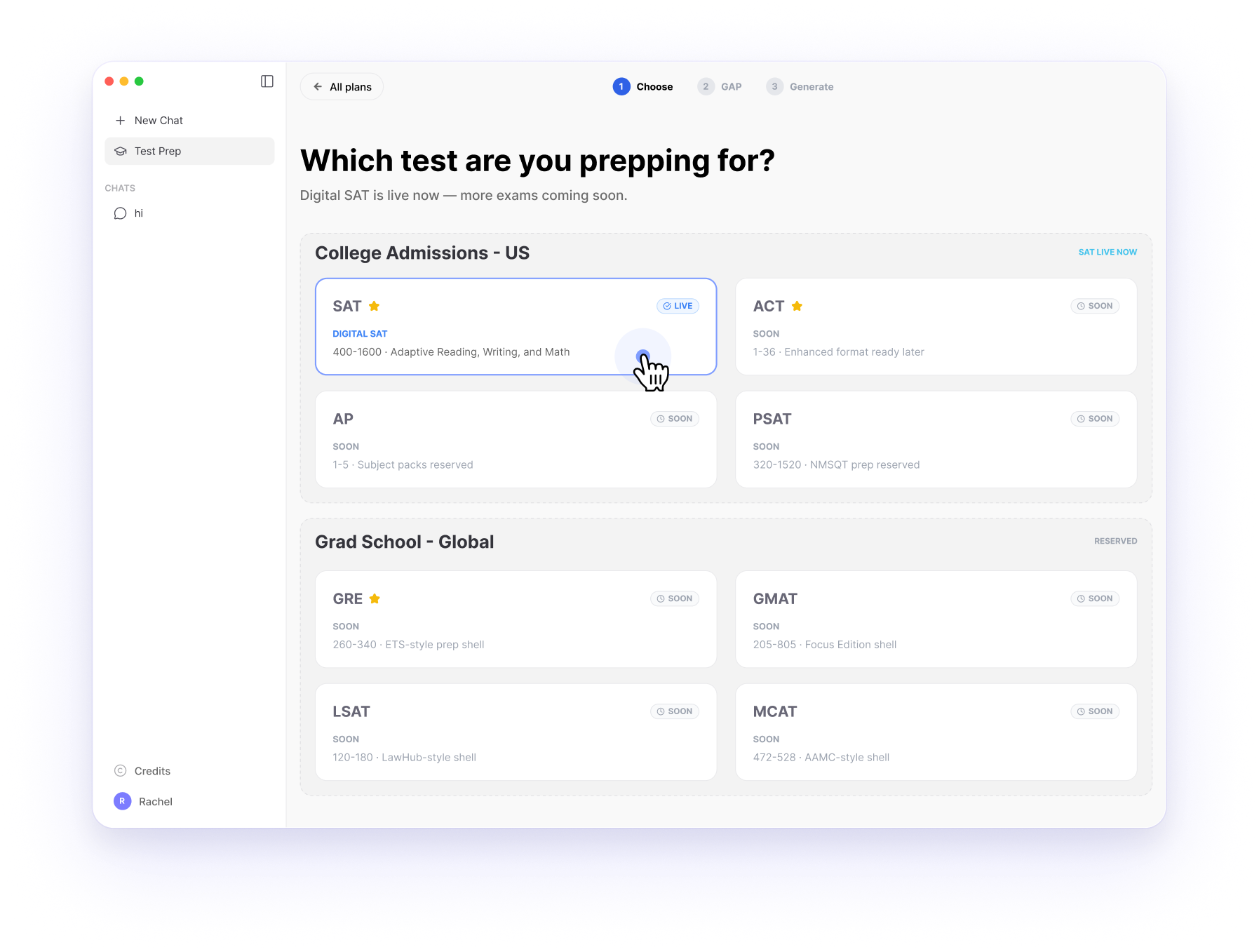
AP Chinese prep in AskSia, step 1: diagnose which units are actually at risk
Step 1

Diagnose which units are actually at risk

Take a short diagnostic. Sia returns an AP score range and shows which of the 6 units are losing you marks, rather than which ones feel hard.
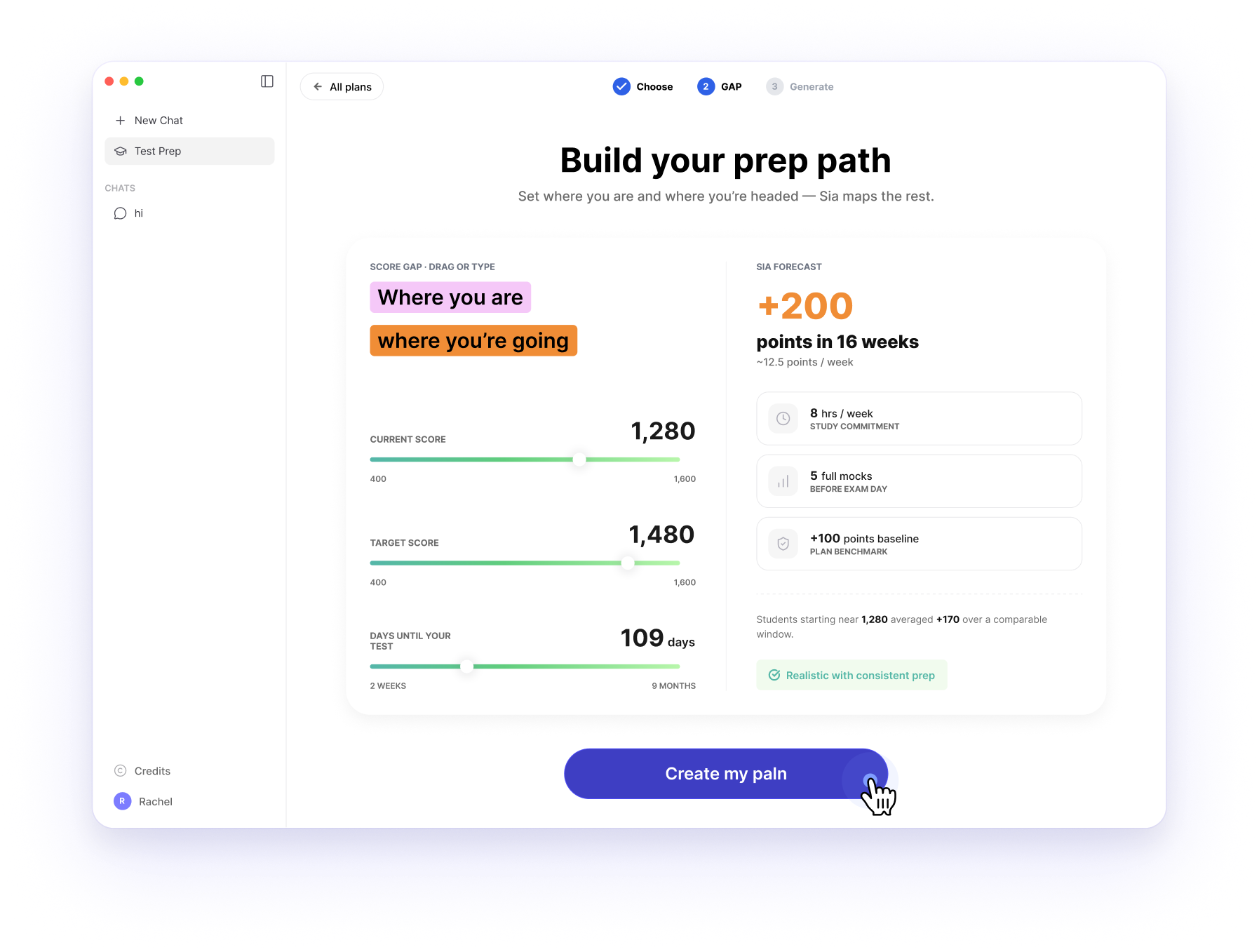
AP Chinese prep in AskSia, step 2: build backwards from 13 may 2027
Step 2

Build backwards from 13 May 2027

Choose your target score. Sia assigns every study day between now and exam day, weighted by the published exam weights rather than by syllabus order.
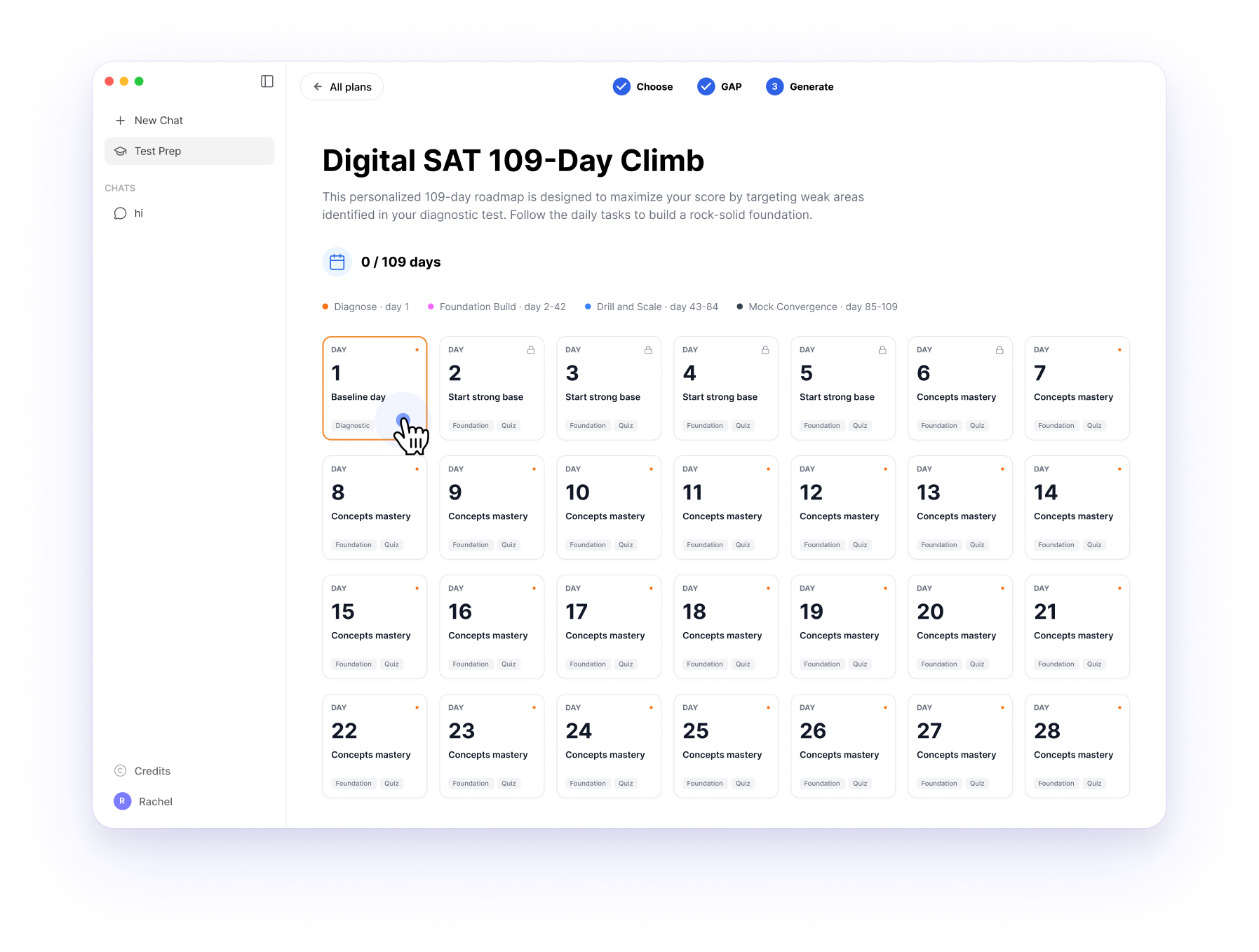
AP Chinese prep in AskSia, step 3: practise, get marked, and re-plan
Step 3

Practise, get marked, and re-plan

Work exam-format multiple choice and free response. Every miss produces coaching on the specific trap or the specific rubric point, then tomorrow's plan changes around it.

The loop runs after every session
  • Sia measures which skills and traps cost you points.
  • Your live score forecast moves with the evidence.
  • The next study block is rewritten around what changed.
A project, then the exam

35% of your score is decided by a project you start in January.

The world language exams were rebuilt for 2027. The free response now comes first, and its two speaking questions both run off a through-course project whose topic College Board releases in January. The Project Presentation is 20% of the score and the Project Q&A is another 15%. Neither is something you can revise for in May, and your Personalized Project Reference has to be submitted through the AP Digital Portfolio by 30 April 2027.

The January topic release is a planning date

Sia treats the project as months of work rather than a task that appears in spring, because the research behind it is what the Q&A actually tests.

The Q&A cannot be scripted, so it is rehearsed unscripted

Four pre-recorded questions you have not seen, 40 seconds each. A memorised presentation does not survive them. Drills use questions you have not seen either.

Speaking is recorded in Bluebook, so practice is too

Preparing on paper and speaking for the first time into a microphone on exam day costs marks that have nothing to do with your language. The clock and the recording are part of the task.

Marking follows the published rubric structure. It is AskSia's, not College Board's, and is a study aid rather than an official score.
A worked question

What a marked answer actually looks like.

One question in the AP Chinese free-response format, worked through the way the rubric reads it, with the point that goes missing flagged at each step.

Free response, four unseen questions

Your course project this year is on music, and the community you researched is a housing compound in Chengdu where neighbours dance to recorded music in the square every evening. The recorded interlocutor introduces herself, then poses four questions you have not seen. This is the third of them. 你研究这个题目的时候用了哪些资料?请说说其中一份资料告诉了你什么。 (What materials did you use when you researched this topic? Tell us what one of them told you.)

Answer in Chinese. The recording starts when the question ends and you have 40 seconds for this turn.

Question 2: Project Q&A. Written by AskSia in the published free-response format. This is not a College Board question, and AskSia does not reproduce official questions or past papers.

1Answer the question
Take both halves in the order they were asked, the materials first and then the single finding. 我用了三种资料:小区微信群的歌单、两位阿姨的访谈,还有一篇报道。歌单告诉我,他们每个月都换新歌。 (I used three kinds of material, the playlist in the compound's WeChat group, interviews with two of the women who dance, and a news report. The playlist told me they change to new songs every month.)
Where the point goes. Row A, Task Execution, is scored once across the whole exchange, and its two-point band asks for the requested information in at least three of the four turns. The turn that spends the point is the one where a rehearsed paragraph about the project arrives instead of an answer, and a two-part question counts as answered only when both parts are.
2Name the value
Nothing in this question asked about culture, so put the perspective in yourself and set it against your own community. 对他们来说,音乐要放得大声,因为跳舞是给整个小区看的,热闹就是面子。我住的地方正好相反,大家戴着耳机跑步。 (For them the music has to be loud, because the dancing is for the whole compound to see, and a lively square is a matter of face. Where I live it is the opposite, people run with headphones on.)
Where the point goes. Row B, Cultural Understanding, is the row you lose while being entirely accurate. Describing the songs, the playlist and the dancing is one point. The second point needs one answer, anywhere in the four, that either compares that community with your own or ties a value or belief to the practice, and no interlocutor question is guaranteed to ask you for it.
3Talk around it
Row C is the only three-point row in this question, and it pays for range and for repair. 虽然他们每个月都换新歌,但是节奏和步子的要求没变。 (Although they change to new songs every month, what the rhythm and the steps demand does not change.) If 歌单 will not come, define it instead: 他们在微信群里放一张名单,上面写着这个月要跳的歌。 (they put a list in the WeChat group with the songs for this month.)
Where the point goes. The one-point band of Row C, Language Control, names reliance on English when the vocabulary will not come, so a single English noun dropped into the Chinese pulls down the one row here that is worth three. Circumlocution holds it, and so does correcting yourself out loud, because the top band credits a response that gets clearer when you clarify or repair it.
4Cut the preamble
Open on the answer. 这个问题问得很好,让我想一想 (that is a very good question, let me think for a moment) spends about five seconds and carries no content, and by the fourth turn a reader has heard it four times. The two parts above run to roughly ninety characters, about thirty-five seconds at an even pace, so the forty seconds are already spoken for.
Where the point goes. Row D, Fluency, counts hesitancy, repetition and filler, and a memorised opener has become filler by the fourth time a reader hears it. Stopping early is not the risk it feels like, because the published Additional Notes say a response that satisfies the criteria without using the whole 40 seconds is still eligible for the maximum in this category.
Built around your score goal

A tutor, planner and test centre in one agent.

AskSia handles the whole AP Chinese prep loop instead of giving you another pile of questions.

Four weeks of planweighted
heaviest units mid weight light
Task-weighted daily plan

Every day has a job, and the plan changes with you.

Sia plans backwards from Thursday 13 May 2027 and weights each exam task by what it is worth on the paper. Finish early, fall behind, or fix a weak task and the next session changes automatically.

  • Days allocated by published exam weight, not syllabus order
  • A realistic target and live score range, not false precision
  • Automatic re-planning after every completed session
Section I, free response first50%
1Project Presentation · 20% · 3 min prepare, 3 min present
2Project Q&A · 15% · 4 unseen questions, 40 sec each
3Independent of your project topic
Section II, the multiple choice, comes after.
Rubric-level free-response marking

It names the point you missed, not just the grade.

AP free responses are scored on discrete rubric points. Sia marks your response point by point and tells you which requirement was not met, then drills that requirement specifically.

  • Point-by-point marking against the published rubric structure
  • Identifies the requirement you missed, not a vague grade
  • Follow-up practice on the same rubric point in new content
Exam day timingabout 2 hr
50%50%
Section I 4 free-response questions, 40 to 45 minutes, 50% of the score
Section II 55 multiple-choice questions, 65 minutes, 50% of the score
Fully Digital in Bluebook
Exam-format fidelity

AP Chinese practice built to the fully digital format.

Practise in a full-screen interface with real section timing, figures and tables. From 2027 every AP exam is digital, so paper-only practice no longer matches exam day.

  • Section timing matched to the real exam blocks
  • Practice selected for the units where you are losing marks
  • A live AP score estimate that updates after every session
AP Chinese practice tests

Practice built around your mistakes.

AskSia writes questions to the published Course and Exam Description format, then selects the ones you personally need. Every result updates your forecast and the next block of days.

Personalised

The set is chosen for you

Your diagnostic maps every unit. Sia selects questions at your difficulty band in the units where you are losing marks.

Full-length

Full-length practice exams

Both sections at real pacing: 4 free-response questions, 40 to 45 minutes, 50% of the score then 55 multiple-choice questions, 65 minutes, 50% of the score.

By unit

Drill a single unit

Work one unit when that is the gap, or let Sia choose based on where marks are leaking against exam weight.

Free

Free AP Chinese practice, no credit card

The free tier includes the diagnostic, your plan, exam-format questions and coaching on every mistake.

1Sit a practice exam2Sia marks it to rubric3Your forecast moves4Tomorrow's plan changes
Why AskSia

Four things the big players do not do.

Web apps hand you a question dump. Human tutors cost thousands. Official prep has no coaching. AskSia is a different category.

An agent, not a chatbot

Sia diagnoses, sets a target, builds the plan to 13 May 2027, drills you and re-plans around your weakest units.

vs. type-a-question tools

Weighted by what each part is worth

Study days are allocated by published exam weight, so a heavy part gets the hours it deserves and a light one does not.

vs. syllabus-order revision

Rubric-level FRQ marking

Sia names the specific rubric point you missed rather than handing back a number out of ten.

vs. “good answer, 6/10”

Free to start · $79 to finish

Prep on the free tier, then open the full bank and all practice exams for a one-time price.

vs. $80 to $200/hour tutors
Why it runs on your desktop

A browser tab cannot sit an exam with you.

AP exams are digital and timed from 2027. AskSia is built as a real app on your machine, with your class notes and study history available.

Real exam conditions

Full-screen mode with real section timing. Practise the way you will actually sit the exam.

It reads your material

Add your class notes, a past FRQ, a screenshot or a textbook PDF. Sia finds patterns in your errors and folds them into the plan.

Works offline after launch

Your plan and question bank stay on the machine so you can drill in a library, in class, or on a plane.

One click from your dock

Open today's session without deciding what to study. That is how students keep a streak through a nine-month course.

macOS 12+ (Apple silicon & Intel)Windows 10 & 11Code signed · free tier · no credit card
Loved by 2M+ students

The agent students already study with.

Sia has supported coursework, lectures and revision across more than 2,000 universities and high schools. AP Chinese prep uses the same agent, pointed at one exam.

2M+
students worldwide
2,000+
universities & high schools
iOS & Android
★★★★★
Best Study Tool

"Love AskSia! I use it on my laptop everyday. I really like the summary and practice quizzes it creates."

M
MiniCh33se
App Store review
★★★★★
Best ai for college students

"This is hands down the best ai tool for college students!! I've been telling my friends all about it, and they're hesitant at first but they end up using it because of how useful it is."

H
Hammerboe
App Store review
★★★★★
Like this app

"My final week savior. Can't live without this for my graduate."

O
Oyhhhhhhhhhh
App Store review
★★★★★
Accurate Recording, Super Helpful for Classes

"The recording feature is really good and accurate. I use it every class, and it helps me a lot with reviewing and organizing my notes. Definitely a useful tool for students!"

B
BROLIN12138
App Store review
★★★★
Easy A+

"I love using this in class to transcribe my lectures. Never miss a word the professor says."

A
Amberrrrrrrrrrr2353
App Store review
★★★★★
Hardworking team and best recording service for AI

"Recording features are the best on the market, I can even ask question during the recording."

N
Nolan970326
App Store review

Reviews published verbatim from the Apple App Store. They describe AskSia as a study agent rather than AP Chinese outcomes specifically. Results depend on your starting point, your test date and the hours you put in.

Compare AP Chinese prep

A complete plan, not another content library.

Compare the parts that determine whether a year of coursework turns into a score.

Comparison of AskSia with official practice, human tutors and question banks for AP Chinese
AskSiaOfficial practiceHuman tutorReview book
Typical priceFree / $79 onceFree with class$80 to $200/hr$15 to $25
Adaptive daily plansometimes
Weighted by published task weightsometimes
Rubric-level FRQ marking
Questions selected for your gapssometimes
Digital exam-format practicevaries
Live AP score forecastLimited
Plans backwards from exam daysometimes

Competitor pricing and features are typical ranges as of August 2026 and vary by provider and plan.

Exam day

AP Chinese exam date 2027, and how many days you have left.

AP exams run over two weeks in May and there is one date for this subject. That single fixed point is what makes an AP plan easy to build backwards from, and expensive to start late.

Section I4 free-response questions, 40 to 45 minutes, 50% of the score
Section IIMultiple-Choice Questions55 multiple-choice questions, 65 minutes, 50% of the score

Section weighting for the AP Chinese Language and Culture exam. Total testing time about 2 hr.

13 May 2027
Exam date, Session 2
Days from today
Fully Digital
Sat in the College Board Bluebook app
1 to 5
Scores, usually early July

Session 1 exams start at 8am local time and Session 2 at 12pm local time for most schools, including all schools in the lower 48 states, Hawaii and Washington DC. Late testing runs 17 to 21 May 2027. Dates are published by the College Board and can change. Your AP coordinator tells you when and where you sit the exam.

Free on Mac & Windows · no credit card · plan ready in about 3 minutes
Taking more than one

Most students sit three or four.

Sia plans all of them in one calendar, so a heavy week for one subject is a light week for another instead of two plans competing for the same evening.

Reach your goal

Every day is planned
backwards from 13 May 2027.

Sia starts from the score you need and the one date you have, then works backwards. If you fall behind, tomorrow changes. If a unit is fixed, it stops appearing.

  • 1Set your target AP score and confirm your exam date.
  • 2Sia forecasts what the gap realistically takes and tells you when it is a stretch.
  • 3Every session moves the forecast, so you always know whether you are on pace.
On pace, or told why not
No false promises
Sia will not pretend a 2 to a 5 in three weeks is easy. It shows what is reachable and builds for that.
Set my goal free or sign up free in your browser
Simple pricing

Start free. Finish for $79.

One flat price for the complete AP Chinese plan. No subscription and no hourly meter.

Free
$0
Free forever · no credit card
  • Diagnostic and score range
  • Day-by-day adaptive plan
  • Exam-format practice and mistake coaching
  • Live score forecast
  • Full question bank and every mock
  • Unlimited retakes and replays
Download free
Most popular
$79one-time
Everything in Free, plus:
  • Complete question bank
  • All full-length practice exams and FRQ sets
  • Goal-locked planning after every session
  • Unlimited retake replays
  • Priority coaching on every mistake
Get the full plan · $79

Less than one hour with a private tutor. One-time payment, no renewal.

Built responsibly

Who makes this, and how the numbers work.

Prep should improve learning without pretending to be official material or promising impossible gains.

Original AskSia questions

Questions follow the published Course and Exam Description format but do not reproduce official questions, past papers or retired content.

Your study history stays protected

Your plan, files and performance are handled under AskSia's privacy and security controls.

Forecasts show uncertainty

Sia uses score ranges and tells you when a target is a stretch instead of promising a guaranteed result.

No unsupported score claims

AskSia does not promise a specific score or publish invented gains. Forecasts update from your own work and remain projections, not guarantees. AskSia is not affiliated with, endorsed by or reviewed by the College Board.

Frequently asked questions

Questions, answered.

The AP Chinese Language and Culture exam is on Thursday 13 May 2027, in Session 2. Session 1 exams start at 8am local time and Session 2 at 12pm local time for most schools, including all schools in the lower 48 states, Hawaii and Washington DC. Late testing runs 17 to 21 May 2027. Your AP coordinator confirms where and when you sit it.
The exam is about 2 hr long. The free-response section comes first: Section I is 4 free-response questions, 40 to 45 minutes, 50% of the score, and Section II is 55 multiple-choice questions, 65 minutes, 50% of the score. It is a fully digital exam. Calculators are not permitted. Speaking responses are recorded directly in Bluebook.
Listening and reading are 25% each, so half the exam is two multiple-choice parts of equal weight, though not of equal length: 25 questions in 25 minutes, then 30 questions in 40. The other half is four free-response tasks, and the two heaviest of them, 35% between them, are scored off a course project whose topic College Board does not release until the January before the exam.
AP exams are reported on a 1 to 5 scale. Your raw marks from both sections are combined using the published weightings, then converted to the final score. There is no penalty for a wrong or blank multiple-choice answer, so leaving one blank is never correct strategy. Scores are usually released in early July, and College Board publishes the exact 2027 score-access dates in spring 2027.
In practice, The Project Q&A. Four questions you have not seen, 40 seconds each, on research you did months earlier. Students who prepare a script and never rehearse unscripted answers lose the 15% outright. Sia identifies which of these patterns is costing you marks and drills that specific pattern rather than the topic in general.
No, and no legitimate tool has them. Official AP questions are the copyrighted property of College Board. Every AskSia question is written by AskSia to the published Course and Exam Description format, then selected for the individual student based on the skills they are losing marks on. What matches the real exam is the format: the same question types, section timing, weighting and rubric structure. AP is a registered trademark of the College Board, which does not endorse or review AskSia.
Yes. AskSia is free to download on Mac and Windows with no credit card. The free tier includes the diagnostic, the adaptive day-by-day plan and personalised practice with coaching. The optional $79 one-time upgrade adds the complete question bank and all full-length practice exams.
Yes. From 2027 every AP exam is digital. AP Chinese Language and Culture is a fully digital exam sat in Bluebook. You complete both the multiple-choice and free-response sections on screen, with responses submitted automatically at the end. Practising on paper alone no longer matches exam day, which is why AskSia runs its practice in a full-screen digital interface.
Yes. AskSia is a native desktop app for macOS 12 or later, on Apple silicon and Intel, and for Windows 10 and 11. Both builds are code signed. There are also iOS and Android apps, and AP prep is one of several study modes inside the same account.

Your target score is
a plan away.

Download free, take the diagnostic, and have a day-by-day AP Chinese plan running to 13 May 2027 in about three minutes.

Free on Mac & Windows · $79 one-time for the complete bank and all practice exams