
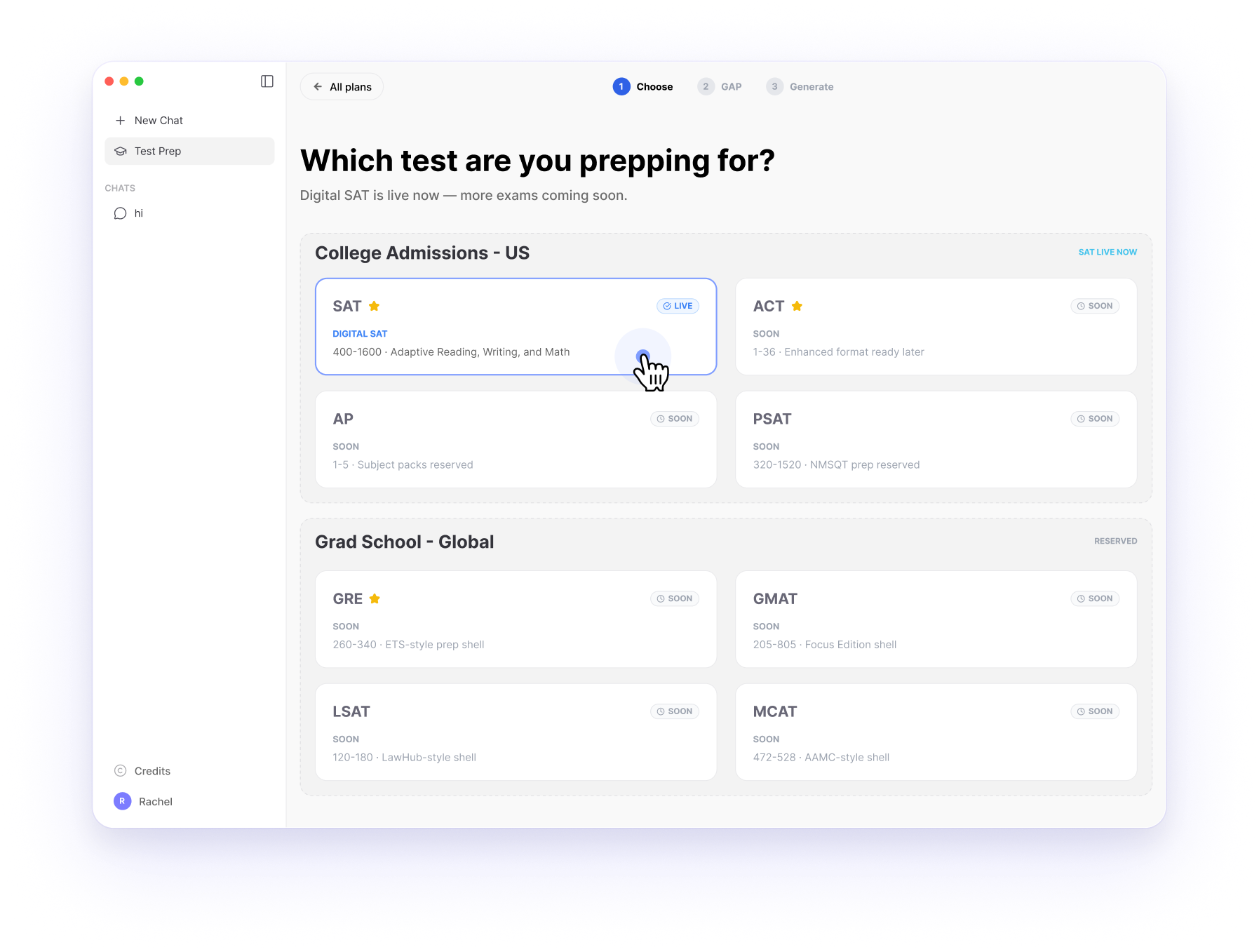
Step 1
Diagnose which units are actually at risk
Take a short diagnostic. Sia returns an AP score range and shows which of the 5 units are losing you marks, rather than which ones feel hard.
Set your target AP score. Sia plans every day between now and Wednesday 5 May 2027, weighted by what each part of the assessment is actually worth, with rubric-level marking on every free response.
Move the sliders. Sia forecasts the gain and maps the days to 5 May 2027.
The AP Cybersecurity® exam is on Wednesday 5 May 2027, Session 1. It runs 2 hr 10 min and is a fully digital exam sat in Bluebook®. Section I is 60 multiple-choice questions, 80 minutes, 70% of the score, and Section II is 1 free-response question, 50 minutes, 30% of the score. It is scored 1 to 5.
Calculators are not permitted. Every exam fact on this page is taken from College Board's official published course and exam materials. AskSia is an independent study tool and is not affiliated with or endorsed by the College Board. Confirm details on the official AP Students site before exam day. Spotted something out of date? Tell us and we will correct it.
College Board publishes no unit-level exam weight for AP Cybersecurity, only a weighting by skill, and all three assessed skill categories carry the same published band on the multiple-choice section. Identical bands cannot tell you which skill to front-load, so the ordering comes from the free-response question, which assesses mitigating risk and detecting attacks only.
Syllabus order is not exam order, so Sia weights your study days by what each skill is worth rather than by when it is taught. College Board does not publish a unit-level exam weight for AP Cybersecurity. The percentages above are its published weighting of the multiple-choice section, which is 70% of the exam score, and College Board publishes them as ranges, so they do not sum to 100%. The free-response question assesses skill categories 2 and 3 only, so mitigating risk and detecting attacks carry more of the whole paper than these bands alone show. Weights are taken from the published Course and Exam Description and can change between years. Last reviewed 27 August 2026.
Three steps turn your current standing, your target and one fixed exam date into a plan that changes as you improve. It takes about three minutes and it is free.
Take a short diagnostic. Sia returns an AP score range and shows which of the 5 units are losing you marks, rather than which ones feel hard.
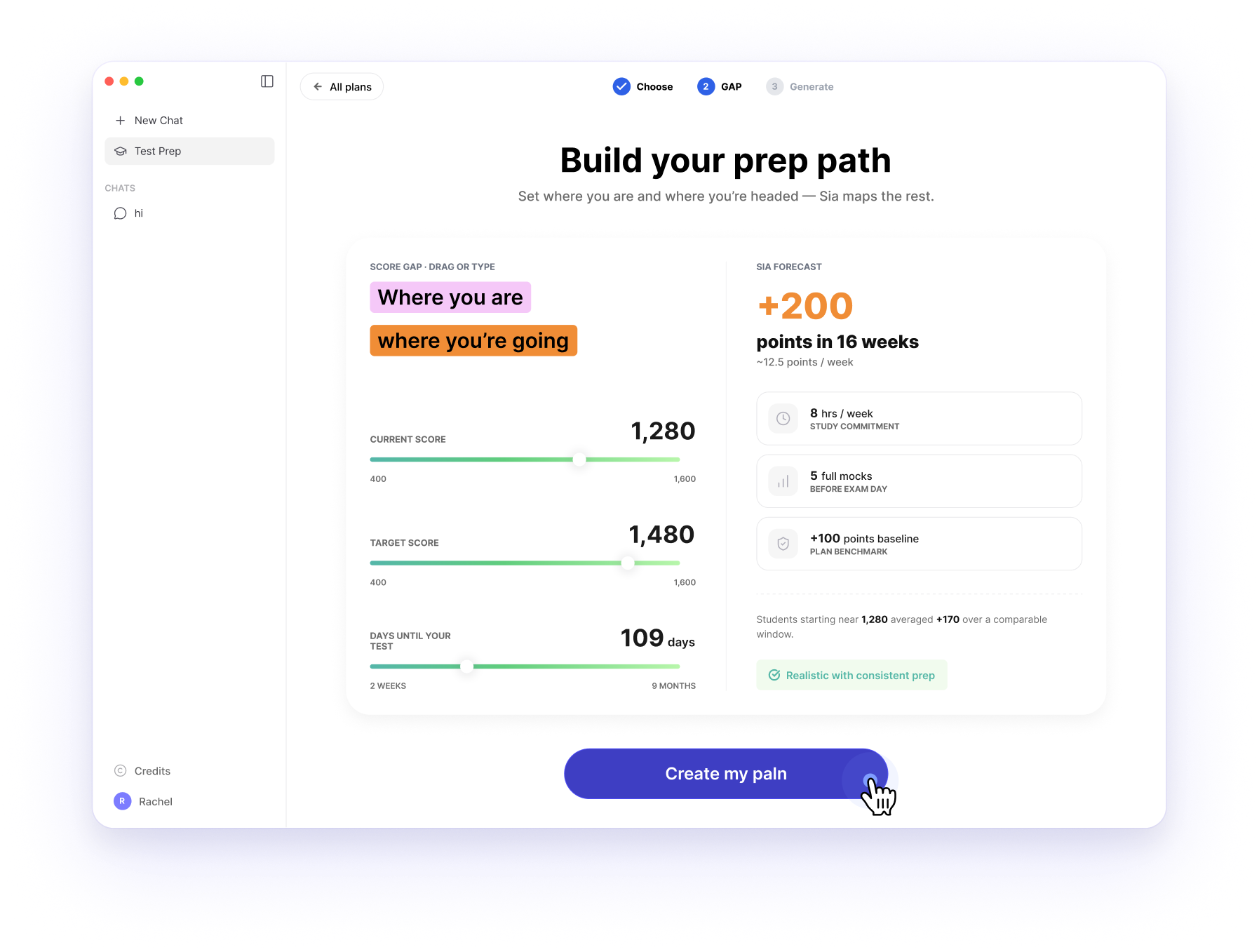
Choose your target score. Sia assigns every study day between now and exam day, weighted by the published exam weights rather than by syllabus order.
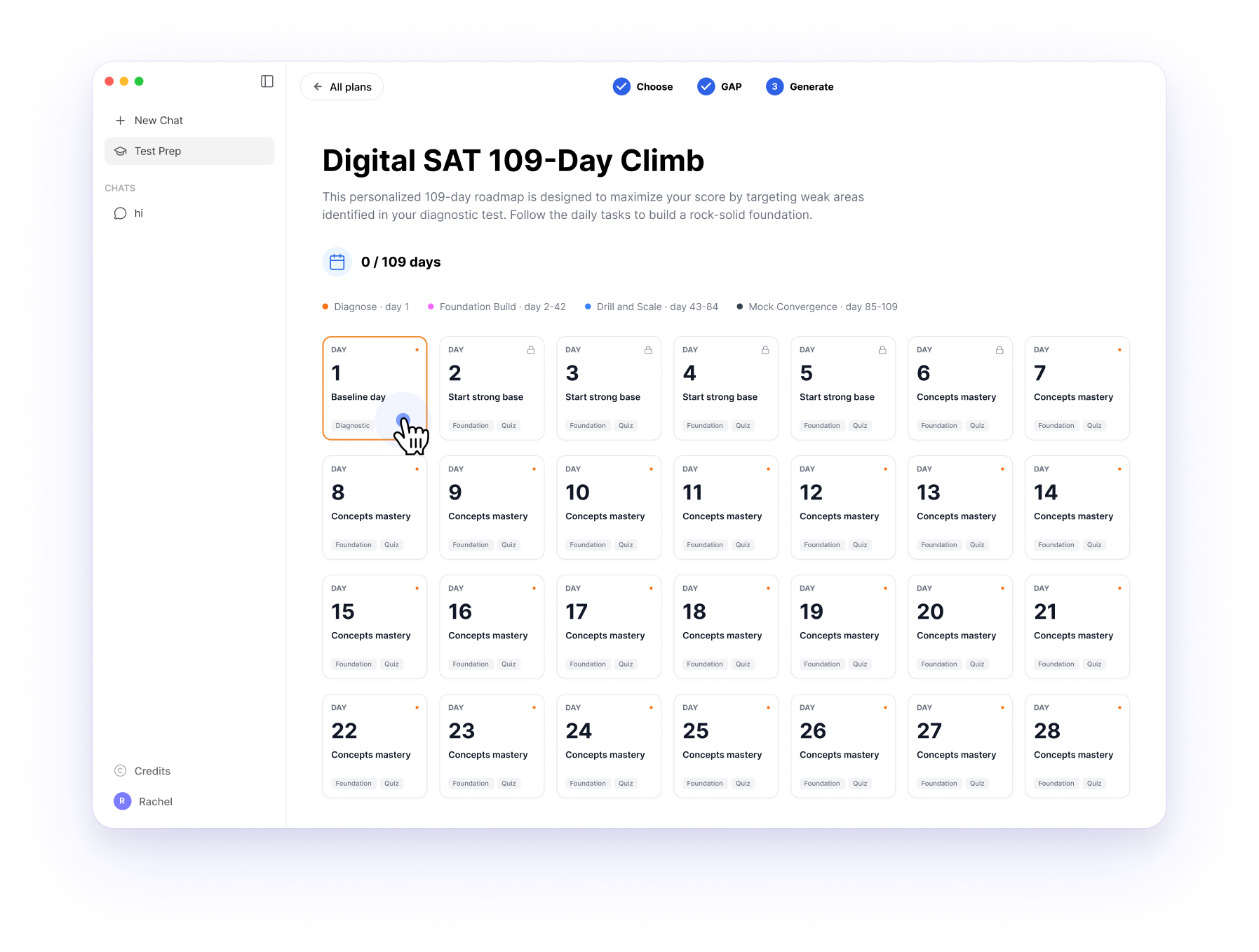
Work exam-format multiple choice and free response. Every miss produces coaching on the specific trap or the specific rubric point, then tomorrow's plan changes around it.
Section II is one question worth 30% of the score, and 50 minutes to answer it. You are handed several kinds of evidence from the same device, typically a set of firewall rules, system and application logs, a file listing with its permissions, and the device policy, and asked to explain the policy, find the attack in the logs, and then write the permission and firewall changes that close it.
The evidence is always sitting in the timestamps and the repeated source address. Sia drills log reading against evidence you have not seen, because recognising an attack name is not the same as finding it in someone else's output.
The fix you write has to implement the change you just described. A stricter command that locks out an account you said should keep access is valid syntax and still scores nothing, so the description and the command are drilled as one answer.
Every part of the question runs off the same evidence, so time lost re-reading the logs for part three is time the last part never gets. Pacing across the parts is rehearsed on full-length tasks.
One question in the AP Cybersecurity free-response format, worked through the way the rubric reads it, with the point that goes missing flagged at each step.
TILL-04 is a payment terminal in a bakery, examined after the card processor reported traffic it did not recognise. The terminal's device policy allows it to reach the processor's network and the vendor's update server, and nothing else. Its host-based firewall carries a rule for every service the terminal accepts and no rule at all for traffic the terminal itself starts. Its connection log shows an outgoing connection to 192.0.2.44, which is neither of those destinations, on port 443, the port the card authorisations use. That connection is made at 23:55 and at every five-minute mark after it until 04:20. Each one carries 2 kB to 4 kB out, except the one at 02:10, which brought 180 kB back. A process the vendor's image does not contain, svc-sync, has been running since 02:12.
Determine what the pattern of outgoing connections shows, explain why the terminal's host-based firewall did nothing about it, describe one change to that firewall, other than taking the terminal off the network, that would have stopped the connections, and describe one effect that change would have on the terminal's other traffic.
Unit 4: Securing devices. Written by AskSia in the published free-response format. This is not a College Board question, and AskSia does not reproduce official questions or past papers.
AskSia handles the whole AP Cybersecurity prep loop instead of giving you another pile of questions.
Sia plans backwards from Wednesday 5 May 2027 and weights each part by what it is worth on the paper. Finish early, fall behind, or fix a unit and the next session changes automatically.
AP free responses are scored on discrete rubric points. Sia marks your response point by point and tells you which requirement was not met, then drills that requirement specifically.
Practise in a full-screen interface with real section timing, figures and tables. From 2027 every AP exam is digital, so paper-only practice no longer matches exam day.
AskSia writes questions to the published Course and Exam Description format, then selects the ones you personally need. Every result updates your forecast and the next block of days.
Your diagnostic maps every unit. Sia selects questions at your difficulty band in the units where you are losing marks.
Both sections at real pacing: 60 multiple-choice questions, 80 minutes, 70% of the score then 1 free-response question, 50 minutes, 30% of the score.
Work one unit when that is the gap, or let Sia choose based on where marks are leaking against exam weight.
The free tier includes the diagnostic, your plan, exam-format questions and coaching on every mistake.
Every AskSia question is written by AskSia to the published Course and Exam Description format. We do not reproduce or resell official AP questions, past papers or retired content. AP® and Advanced Placement® are registered trademarks of the College Board, which is not affiliated with AskSia.
Web apps hand you a question dump. Human tutors cost thousands. Official prep has no coaching. AskSia is a different category.
Sia diagnoses, sets a target, builds the plan to 5 May 2027, drills you and re-plans around your weakest units.
vs. type-a-question toolsStudy days are allocated by published exam weight, so a heavy part gets the hours it deserves and a light one does not.
vs. syllabus-order revisionSia names the specific rubric point you missed rather than handing back a number out of ten.
vs. “good answer, 6/10”Prep on the free tier, then open the full bank and all practice exams for a one-time price.
vs. $80 to $200/hour tutorsAP exams are digital and timed from 2027. AskSia is built as a real app on your machine, with your class notes and study history available.
Full-screen mode with real section timing. Practise the way you will actually sit the exam.
Add your class notes, a past FRQ, a screenshot or a textbook PDF. Sia finds patterns in your errors and folds them into the plan.
Your plan and question bank stay on the machine so you can drill in a library, in class, or on a plane.
Open today's session without deciding what to study. That is how students keep a streak through a nine-month course.
Sia has supported coursework, lectures and revision across more than 2,000 universities and high schools. AP Cybersecurity prep uses the same agent, pointed at one exam.
"Love AskSia! I use it on my laptop everyday. I really like the summary and practice quizzes it creates."
"This is hands down the best ai tool for college students!! I've been telling my friends all about it, and they're hesitant at first but they end up using it because of how useful it is."
"My final week savior. Can't live without this for my graduate."
"The recording feature is really good and accurate. I use it every class, and it helps me a lot with reviewing and organizing my notes. Definitely a useful tool for students!"
"I love using this in class to transcribe my lectures. Never miss a word the professor says."
"Recording features are the best on the market, I can even ask question during the recording."
Reviews published verbatim from the Apple App Store. They describe AskSia as a study agent rather than AP Cybersecurity outcomes specifically. Results depend on your starting point, your test date and the hours you put in.
Compare the parts that determine whether a year of coursework turns into a score.
| AskSia | Official practice | Human tutor | Review book | |
|---|---|---|---|---|
| Typical price | Free / $79 once | Free with class | $80 to $200/hr | $15 to $25 |
| Adaptive daily plan | ✓ | — | sometimes | — |
| Weighted by published exam weight | ✓ | — | sometimes | — |
| Rubric-level FRQ marking | ✓ | — | ✓ | — |
| Questions selected for your gaps | ✓ | — | sometimes | — |
| Digital exam-format practice | ✓ | ✓ | varies | — |
| Live AP score forecast | ✓ | Limited | — | — |
| Plans backwards from exam day | ✓ | — | sometimes | — |
Competitor pricing and features are typical ranges as of August 2026 and vary by provider and plan.
AP exams run over two weeks in May and there is one date for this subject. That single fixed point is what makes an AP plan easy to build backwards from, and expensive to start late.
Section weighting for the AP Cybersecurity exam. Total testing time 2 hr 10 min.
Session 1 exams start at 8am local time and Session 2 at 12pm local time for most schools, including all schools in the lower 48 states, Hawaii and Washington DC. Late testing runs 17 to 21 May 2027. Dates are published by the College Board and can change. Your AP coordinator tells you when and where you sit the exam.
Sia plans all of them in one calendar, so a heavy week for one subject is a light week for another instead of two plans competing for the same evening.
Sia starts from the score you need and the one date you have, then works backwards. If you fall behind, tomorrow changes. If a unit is fixed, it stops appearing.
One flat price for the complete AP Cybersecurity plan. No subscription and no hourly meter.
Less than one hour with a private tutor. One-time payment, no renewal.
Prep should improve learning without pretending to be official material or promising impossible gains.
Questions follow the published Course and Exam Description format but do not reproduce official questions, past papers or retired content.
Your plan, files and performance are handled under AskSia's privacy and security controls.
Sia uses score ranges and tells you when a target is a stretch instead of promising a guaranteed result.
AskSia does not promise a specific score or publish invented gains. Forecasts update from your own work and remain projections, not guarantees. AskSia is not affiliated with, endorsed by or reviewed by the College Board.
Download free, take the diagnostic, and have a day-by-day AP Cybersecurity plan running to 5 May 2027 in about three minutes.
Free on Mac & Windows · $79 one-time for the complete bank and all practice exams


