AP 2027 Friday 7 May 2027 is away. Session 1, fully digital. See exam-day details →
AI AP German tutor · Mac & Windows

The AI AP German tutor that tells you
exactly what to study today.

Set your target AP score. Sia plans every day between now and Friday 7 May 2027, weighted by what each part of the assessment is actually worth, with rubric-level marking on every free response.

Download free Mac & Windows · free, no credit card
Start for free Create a free account, no credit card
2M+ students Planned backwards from the deadline Rubric-level FRQ marking Free tier, no credit card
Set your target in 30 seconds
Live score forecast
Build your AP German prep path

Move the sliders. Sia forecasts the gain and maps the days to 7 May 2027.

Your score gap
Where you are Where you're going
3
15
5
15
6hrs
216
Sia forecast
days to the exam
Friday 7 May 2027, Session 1
Units to cover before exam day
Total study hours at this rate
Unscripted speaking drills
This is a projection from typical progress at your starting band, not a promise. Inside the app, Sia rebuilds it from your real diagnostic after every session.
Realistic with consistent prep
Download on Mac and Windows, or sign up and start in your browser. Your plan is built in about 3 minutes.
AP German Language and Culture at a glance Last reviewed

The AP German Language and Culture® exam is on Friday 7 May 2027, Session 1. It runs about 2 hr 30 min and is a fully digital exam sat in Bluebook®. The free-response section comes first: Section I is 3 free-response questions, 65 to 70 minutes, 50% of the score, and Section II is 55 multiple-choice questions, 80 minutes, 50% of the score. It is scored 1 to 5.

about 2 hr 30 min
Total testing time
55 MCQ
80 minutes, 50% of the score
3 FRQ
65 to 70 minutes, 50% of the score
1 to 5
AP score scale, no penalty for wrong answers
Fully Digital
How the exam is administered in Bluebook
Session 1
Friday 7 May 2027

Calculators are not permitted. Speaking responses are recorded directly in Bluebook. Every exam fact on this page is taken from College Board's official published course and exam materials. AskSia is an independent study tool and is not affiliated with or endorsed by the College Board. Confirm details on the official AP Students site before exam day. Spotted something out of date? Tell us and we will correct it.

Where the marks actually are

AP German task weights, and what that means for your plan.

Listening and reading are 25% each, so half the exam is two multiple-choice parts of equal weight and equal time, 25 listening questions against 30 reading questions in 40 minutes apiece, all of them in sets of exactly five. The other half is the free-response section, where the presentation and the Q&A are 35% between them and both run off a project whose topic is not released until January, which leaves the argumentative essay at 15% as the only Section I task you can revise for from a standing start in spring.

Section I Question 1: Project Presentation
20%
Section I Question 2: Project Q&A
15%
Section I Question 3: Argumentative Essay
15%
Section II Part A: Listening
25%
Section II Part B: Reading
25%
Heaviest tasks. Where a fixed hour returns the most marks. Published task weight, as a share of the total exam score.

Syllabus order is not exam order, so Sia weights your study days by what each part is worth rather than by when it is taught. College Board publishes no per-unit exam weight for AP German Language and Culture, so the figures shown here are the published weight of each scored exam task, and those five tasks account for the whole paper. The six thematic units are examined through these tasks rather than weighted one by one. Weights are taken from the published Course and Exam Description and can change between years. Last reviewed 27 August 2026.

How the AP German agent works

From unknown starting point to a plan you can follow.

Three steps turn your current standing, your target and one fixed exam date into a plan that changes as you improve. It takes about three minutes and it is free.

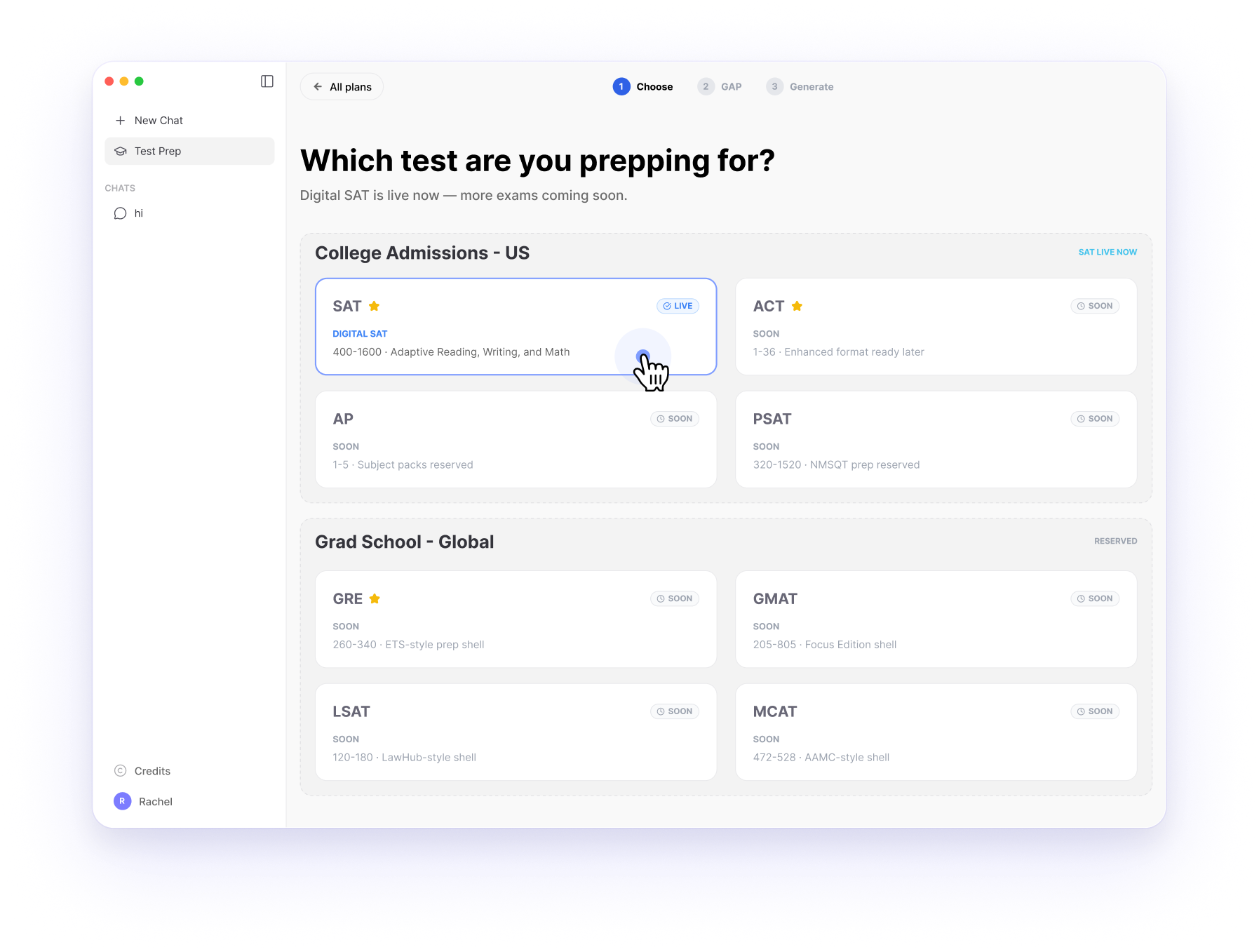
AP German prep in AskSia, step 1: diagnose which units are actually at risk
Step 1

Diagnose which units are actually at risk

Take a short diagnostic. Sia returns an AP score range and shows which of the 6 units are losing you marks, rather than which ones feel hard.
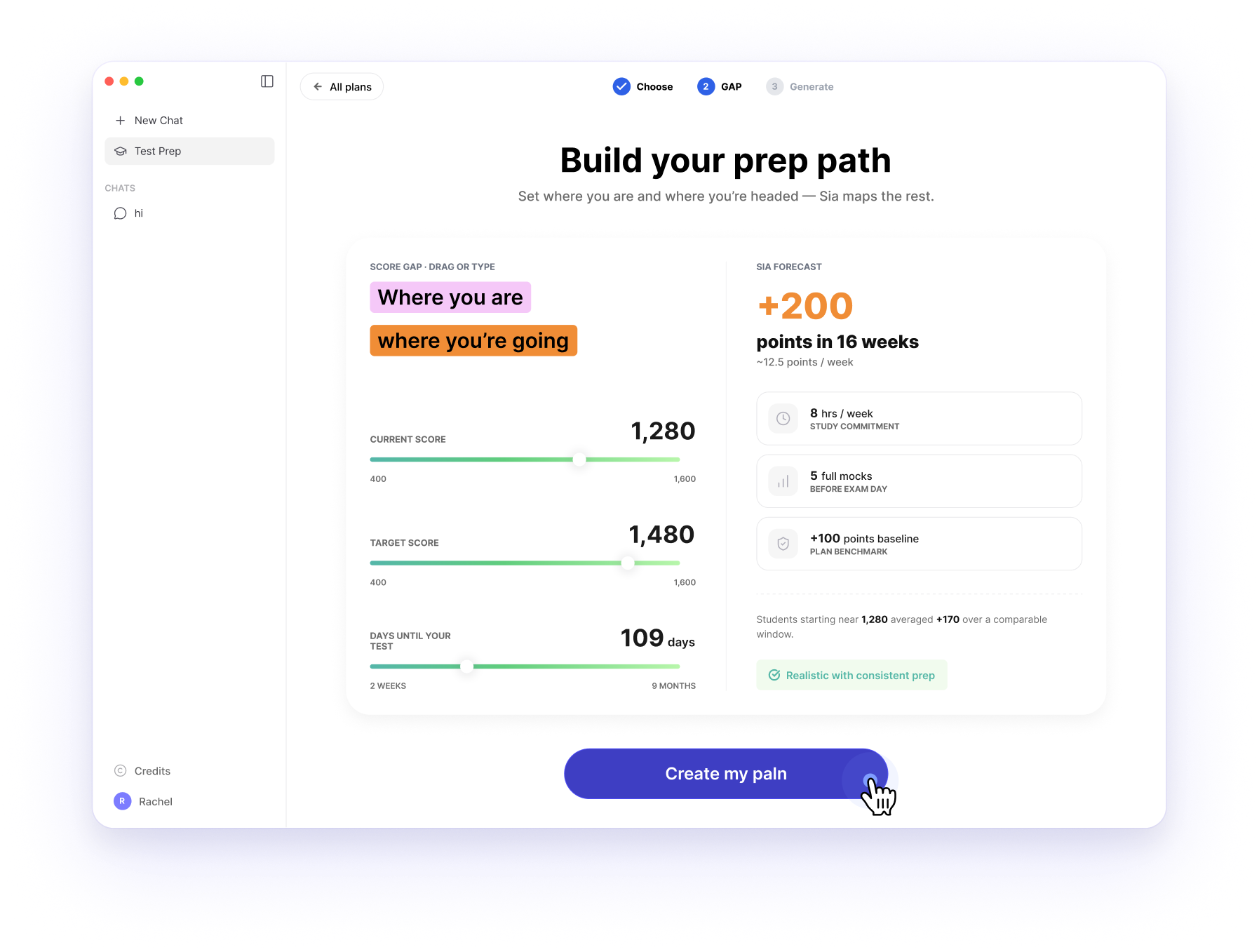
AP German prep in AskSia, step 2: build backwards from 7 may 2027
Step 2

Build backwards from 7 May 2027

Choose your target score. Sia assigns every study day between now and exam day, weighted by the published exam weights rather than by syllabus order.
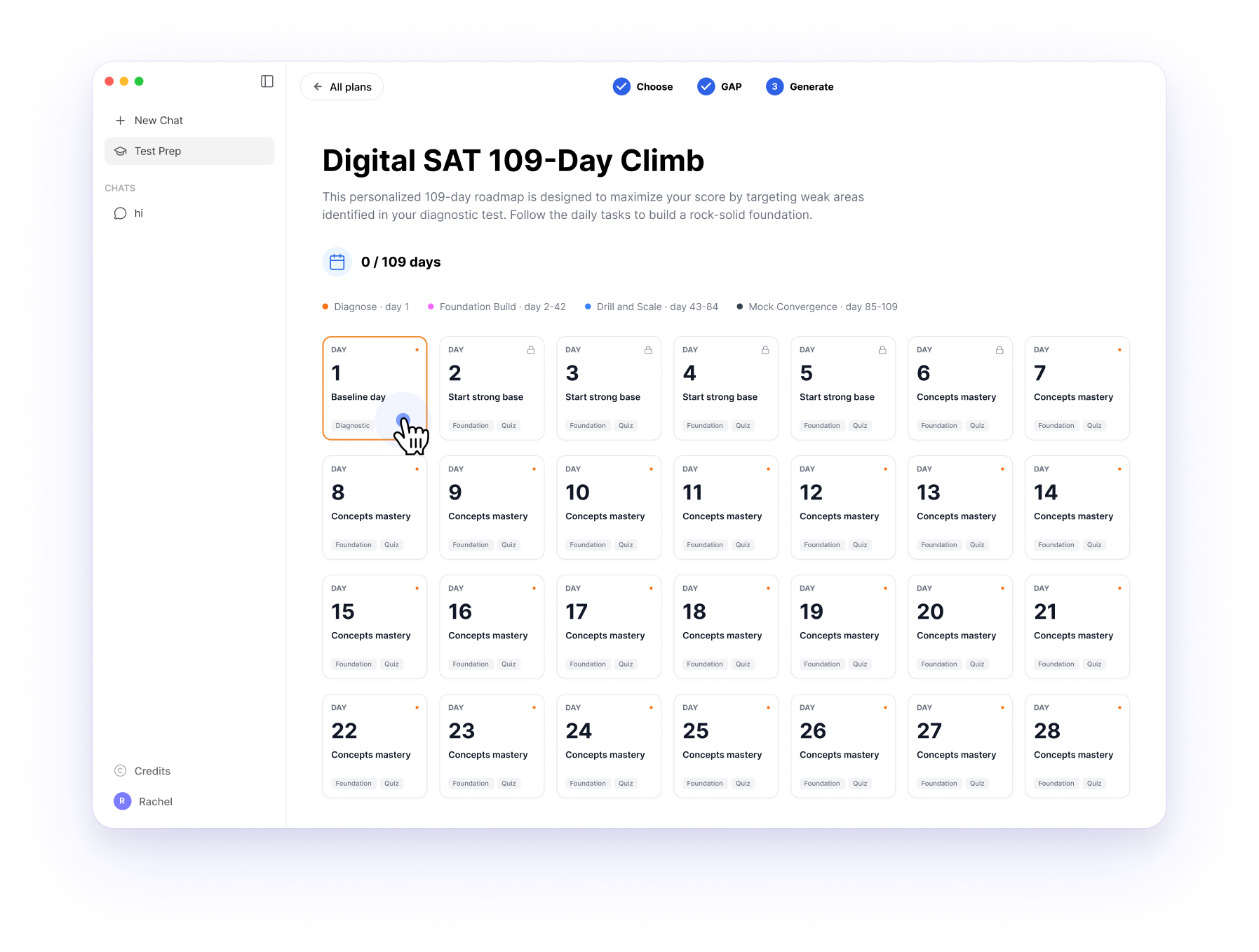
AP German prep in AskSia, step 3: practise, get marked, and re-plan
Step 3

Practise, get marked, and re-plan

Work exam-format multiple choice and free response. Every miss produces coaching on the specific trap or the specific rubric point, then tomorrow's plan changes around it.

The loop runs after every session
  • Sia measures which skills and traps cost you points.
  • Your live score forecast moves with the evidence.
  • The next study block is rewritten around what changed.
A project, then the exam

35% of your score is decided by a project you start in January.

The world language exams were rebuilt for 2027. The free response now comes first, and its two speaking questions both run off a through-course project whose topic College Board releases in January. The Project Presentation is 20% of the score and the Project Q&A is another 15%. Neither is something you can revise for in May, and your Personalized Project Reference has to be submitted through the AP Digital Portfolio by 30 April 2027.

The January topic release is a planning date

Sia treats the project as months of work rather than a task that appears in spring, because the research behind it is what the Q&A actually tests.

The Q&A cannot be scripted, so it is rehearsed unscripted

Four pre-recorded questions you have not seen, 40 seconds each. A memorised presentation does not survive them. Drills use questions you have not seen either.

Speaking is recorded in Bluebook, so practice is too

Preparing on paper and speaking for the first time into a microphone on exam day costs marks that have nothing to do with your language. The clock and the recording are part of the task.

Marking follows the published rubric structure. It is AskSia's, not College Board's, and is a study aid rather than an official score.
A worked question

What a marked answer actually looks like.

One question in the AP German free-response format, worked through the way the rubric reads it, with the point that goes missing flagged at each step.

Argumentative essay, print and audio

Section I Question 3 gives you one prompt and three sources that pull against each other. Source 1 is the audio, an interview with a volunteer at a Leipzig food bank. Source 2 is an article on a supermarket chain that has been giving away unsold stock voluntarily for three years. Source 3 is an infographic showing which sectors German food waste actually comes from. Sollten Supermärkte gesetzlich verpflichtet werden, unverkaufte Lebensmittel abzugeben? Nehmen Sie Stellung und beziehen Sie alle drei Quellen ein. (Should supermarkets be legally required to hand over unsold food? Take a position and draw on all three sources.)

Write the essay in German, 55 minutes for the whole task. The audio is Source 1 but you hear it last, after a six-minute countdown you spend reading the prompt and the two written sources, and it plays twice.

Section I Question 3: Argumentative Essay. Written by AskSia in the published free-response format. This is not a College Board question, and AskSia does not reproduce official questions or past papers.

1Take a side
Put the answer to the prompt in the opening lines, and make it the sentence the rest of the essay has to defend: Supermärkte sollten gesetzlich dazu verpflichtet werden, unverkaufte, aber noch genießbare Lebensmittel abzugeben. Freiwilligkeit erreicht nur die Ketten, die ohnehin schon spenden. (Supermarkets should be legally required to hand over unsold food that is still fit to eat. A voluntary arrangement only reaches the chains that already donate.)
Where the point goes. Row A is one point and the published test is whether the position directly responds to the prompt. It goes to drift far more often than to silence. Lebensmittelverschwendung ist ein großes Problem answers whether food waste matters, not whether the law should compel supermarkets, and a position that misreads the prompt is listed among the responses that earn nothing in this row.
2Name the source
Label each source as you use it, the audio included: Die Grafik in Quelle 3 zeigt, dass der Einzelhandel nur einen kleinen Teil der Verschwendung verursacht, und der Artikel in Quelle 2 beschreibt eine Kette, die seit drei Jahren freiwillig spendet. Im Hörtext, in Quelle 1, berichtet eine Ehrenamtliche der Tafel, dass die Spenden unregelmäßig und oft erst kurz vor dem Mindesthaltbarkeitsdatum ankommen. (The chart in Source 3 shows that retail causes only a small share of the waste, and the article in Source 2 describes a chain that has been donating voluntarily for three years. In the audio, Source 1, a food-bank volunteer reports that donations arrive irregularly and often only just before the best-before date.)
Where the point goes. Row B is two points, and getting all three sources into the essay only takes you to the door of the second one. The published bands separate a response that usually makes the source of information clear from one that does it consistently, and the audio is where consistency slips, because it is the one source you are citing from your notes rather than from text, so it comes out as man sagt. In the 2027 format the audio is Quellenmaterial 1, so the label the marker is waiting for is Quelle 1.
3Back the claim
Every claim needs source material under it, named and used: Der kleine Handelsanteil aus Quelle 3 ist kein Gegenargument, denn eine Abgabepflicht wirkt genau dort, wo die Ware gebündelt und noch verkaufsfähig anfällt. Quelle 1 zeigt außerdem, dass die Tafel nicht an der Menge scheitert, sondern an der Unregelmäßigkeit der Lieferungen. Feste Abgabezeiten machen aus einem Zufallsfund eine planbare Lieferung. (The small retail share in Source 3 is not a counter-argument, because an obligation bites exactly where the goods pile up and are still saleable. Source 1 shows as well that the food bank is not defeated by the quantity but by how irregular the deliveries are. Fixed handover times turn a chance find into a delivery it can plan around.)
Where the point goes. Row C is two points and the second one is bought with evidence, not with conviction. The one-point band names responses that include claims with minimal information or examples to support them, so a confident paragraph arguing from general knowledge, es ist doch klar, dass Supermärkte Verantwortung tragen, sits there however fluent the German is. Two points asks you to quote, paraphrase or summarise something specific from a source and say what it proves, which is the job nicht an der Menge, sondern an der Unregelmäßigkeit is doing.
4Widen the range
Reach for the vocabulary the topic actually needs and for more than one kind of sentence: Würde der Gesetzgeber die Kühlkette mitfinanzieren, ließe sich die Abgabepflicht auch für kleine Filialen umsetzen. Lebensmittel, die heute im Container landen, kämen dann als Spende in Umlauf. (If the legislature co-financed the cold chain, the obligation could be implemented for small branches too. Food that ends up in the skip today would then go into circulation as a donation.)
Where the point goes. Row E is three points, the heaviest single row on this task, and it scores range and accuracy in the same place rather than paying for accuracy on its own. A narrow vocabulary caps this row however few the mistakes, so an essay that calls everything das Essen cannot reach the top band no matter how clean the grammar is. The top band wants a wide variety of vocabulary, expressions appropriate to the topic and control of a variety of grammatical structures, which is what Kühlkette, im Container landen and the conditional above are supplying.
Built around your score goal

A tutor, planner and test centre in one agent.

AskSia handles the whole AP German prep loop instead of giving you another pile of questions.

Four weeks of planweighted
heaviest units mid weight light
Weight-aware daily plan

Every day has a job, and the plan changes with you.

Sia plans backwards from Friday 7 May 2027 and weights each task by what it is worth on the paper. Finish early, fall behind, or fix a unit and the next session changes automatically.

  • Days allocated by published exam weight, not syllabus order
  • A realistic target and live score range, not false precision
  • Automatic re-planning after every completed session
Section I, free response first50%
1Project Presentation · 20% · 3 min prepare, 3 min present
2Project Q&A · 15% · 4 unseen questions, 40 sec each
3Independent of your project topic
Section II, the multiple choice, comes after.
Rubric-level free-response marking

It names the point you missed, not just the grade.

AP free responses are scored on discrete rubric points. Sia marks your response point by point and tells you which requirement was not met, then drills that requirement specifically.

  • Point-by-point marking against the published rubric structure
  • Identifies the requirement you missed, not a vague grade
  • Follow-up practice on the same rubric point in new content
Exam day timingabout 2 hr 30 min
50%50%
Section I 3 free-response questions, 65 to 70 minutes, 50% of the score
Section II 55 multiple-choice questions, 80 minutes, 50% of the score
Fully Digital in Bluebook
Exam-format fidelity

AP German practice built to the fully digital format.

Practise in a full-screen interface with real section timing, figures and tables. From 2027 every AP exam is digital, so paper-only practice no longer matches exam day.

  • Section timing matched to the real exam blocks
  • Practice selected for the units where you are losing marks
  • A live AP score estimate that updates after every session
AP German practice tests

Practice built around your mistakes.

AskSia writes questions to the published Course and Exam Description format, then selects the ones you personally need. Every result updates your forecast and the next block of days.

Personalised

The set is chosen for you

Your diagnostic maps every unit. Sia selects questions at your difficulty band in the units where you are losing marks.

Full-length

Full-length practice exams

Both sections at real pacing: 3 free-response questions, 65 to 70 minutes, 50% of the score then 55 multiple-choice questions, 80 minutes, 50% of the score.

By unit

Drill a single unit

Work one unit when that is the gap, or let Sia choose based on where marks are leaking against exam weight.

Free

Free AP German practice, no credit card

The free tier includes the diagnostic, your plan, exam-format questions and coaching on every mistake.

1Sit a practice exam2Sia marks it to rubric3Your forecast moves4Tomorrow's plan changes
Why AskSia

Four things the big players do not do.

Web apps hand you a question dump. Human tutors cost thousands. Official prep has no coaching. AskSia is a different category.

An agent, not a chatbot

Sia diagnoses, sets a target, builds the plan to 7 May 2027, drills you and re-plans around your weakest units.

vs. type-a-question tools

Weighted by what each part is worth

Study days are allocated by published exam weight, so a heavy part gets the hours it deserves and a light one does not.

vs. syllabus-order revision

Rubric-level FRQ marking

Sia names the specific rubric point you missed rather than handing back a number out of ten.

vs. “good answer, 6/10”

Free to start · $79 to finish

Prep on the free tier, then open the full bank and all practice exams for a one-time price.

vs. $80 to $200/hour tutors
Why it runs on your desktop

A browser tab cannot sit an exam with you.

AP exams are digital and timed from 2027. AskSia is built as a real app on your machine, with your class notes and study history available.

Real exam conditions

Full-screen mode with real section timing. Practise the way you will actually sit the exam.

It reads your material

Add your class notes, a past FRQ, a screenshot or a textbook PDF. Sia finds patterns in your errors and folds them into the plan.

Works offline after launch

Your plan and question bank stay on the machine so you can drill in a library, in class, or on a plane.

One click from your dock

Open today's session without deciding what to study. That is how students keep a streak through a nine-month course.

macOS 12+ (Apple silicon & Intel)Windows 10 & 11Code signed · free tier · no credit card
Loved by 2M+ students

The agent students already study with.

Sia has supported coursework, lectures and revision across more than 2,000 universities and high schools. AP German prep uses the same agent, pointed at one exam.

2M+
students worldwide
2,000+
universities & high schools
iOS & Android
★★★★★
Best Study Tool

"Love AskSia! I use it on my laptop everyday. I really like the summary and practice quizzes it creates."

M
MiniCh33se
App Store review
★★★★★
Best ai for college students

"This is hands down the best ai tool for college students!! I've been telling my friends all about it, and they're hesitant at first but they end up using it because of how useful it is."

H
Hammerboe
App Store review
★★★★★
Like this app

"My final week savior. Can't live without this for my graduate."

O
Oyhhhhhhhhhh
App Store review
★★★★★
Accurate Recording, Super Helpful for Classes

"The recording feature is really good and accurate. I use it every class, and it helps me a lot with reviewing and organizing my notes. Definitely a useful tool for students!"

B
BROLIN12138
App Store review
★★★★
Easy A+

"I love using this in class to transcribe my lectures. Never miss a word the professor says."

A
Amberrrrrrrrrrr2353
App Store review
★★★★★
Hardworking team and best recording service for AI

"Recording features are the best on the market, I can even ask question during the recording."

N
Nolan970326
App Store review

Reviews published verbatim from the Apple App Store. They describe AskSia as a study agent rather than AP German outcomes specifically. Results depend on your starting point, your test date and the hours you put in.

Compare AP German prep

A complete plan, not another content library.

Compare the parts that determine whether a year of coursework turns into a score.

Comparison of AskSia with official practice, human tutors and question banks for AP German
AskSiaOfficial practiceHuman tutorReview book
Typical priceFree / $79 onceFree with class$80 to $200/hr$15 to $25
Adaptive daily plansometimes
Weighted by published exam weightsometimes
Rubric-level FRQ marking
Questions selected for your gapssometimes
Digital exam-format practicevaries
Live AP score forecastLimited
Plans backwards from exam daysometimes

Competitor pricing and features are typical ranges as of August 2026 and vary by provider and plan.

Exam day

AP German exam date 2027, and how many days you have left.

AP exams run over two weeks in May and there is one date for this subject. That single fixed point is what makes an AP plan easy to build backwards from, and expensive to start late.

Section I3 free-response questions, 65 to 70 minutes, 50% of the score
Section IIMultiple-Choice Questions55 multiple-choice questions, 80 minutes, 50% of the score

Section weighting for the AP German Language and Culture exam. Total testing time about 2 hr 30 min.

7 May 2027
Exam date, Session 1
Days from today
Fully Digital
Sat in the College Board Bluebook app
1 to 5
Scores, usually early July

Session 1 exams start at 8am local time and Session 2 at 12pm local time for most schools, including all schools in the lower 48 states, Hawaii and Washington DC. Late testing runs 17 to 21 May 2027. Dates are published by the College Board and can change. Your AP coordinator tells you when and where you sit the exam.

Free on Mac & Windows · no credit card · plan ready in about 3 minutes
Taking more than one

Most students sit three or four.

Sia plans all of them in one calendar, so a heavy week for one subject is a light week for another instead of two plans competing for the same evening.

Reach your goal

Every day is planned
backwards from 7 May 2027.

Sia starts from the score you need and the one date you have, then works backwards. If you fall behind, tomorrow changes. If a unit is fixed, it stops appearing.

  • 1Set your target AP score and confirm your exam date.
  • 2Sia forecasts what the gap realistically takes and tells you when it is a stretch.
  • 3Every session moves the forecast, so you always know whether you are on pace.
On pace, or told why not
No false promises
Sia will not pretend a 2 to a 5 in three weeks is easy. It shows what is reachable and builds for that.
Set my goal free or sign up free in your browser
Simple pricing

Start free. Finish for $79.

One flat price for the complete AP German plan. No subscription and no hourly meter.

Free
$0
Free forever · no credit card
  • Diagnostic and score range
  • Day-by-day adaptive plan
  • Exam-format practice and mistake coaching
  • Live score forecast
  • Full question bank and every mock
  • Unlimited retakes and replays
Download free
Most popular
$79one-time
Everything in Free, plus:
  • Complete question bank
  • All full-length practice exams and FRQ sets
  • Goal-locked planning after every session
  • Unlimited retake replays
  • Priority coaching on every mistake
Get the full plan · $79

Less than one hour with a private tutor. One-time payment, no renewal.

Built responsibly

Who makes this, and how the numbers work.

Prep should improve learning without pretending to be official material or promising impossible gains.

Original AskSia questions

Questions follow the published Course and Exam Description format but do not reproduce official questions, past papers or retired content.

Your study history stays protected

Your plan, files and performance are handled under AskSia's privacy and security controls.

Forecasts show uncertainty

Sia uses score ranges and tells you when a target is a stretch instead of promising a guaranteed result.

No unsupported score claims

AskSia does not promise a specific score or publish invented gains. Forecasts update from your own work and remain projections, not guarantees. AskSia is not affiliated with, endorsed by or reviewed by the College Board.

Frequently asked questions

Questions, answered.

The AP German Language and Culture exam is on Friday 7 May 2027, in Session 1. Session 1 exams start at 8am local time and Session 2 at 12pm local time for most schools, including all schools in the lower 48 states, Hawaii and Washington DC. Late testing runs 17 to 21 May 2027. Your AP coordinator confirms where and when you sit it.
The exam is about 2 hr 30 min long. The free-response section comes first: Section I is 3 free-response questions, 65 to 70 minutes, 50% of the score, and Section II is 55 multiple-choice questions, 80 minutes, 50% of the score. It is a fully digital exam. Calculators are not permitted. Speaking responses are recorded directly in Bluebook.
Listening and reading are 25% each, so half the exam is two multiple-choice parts of equal weight and equal time, 25 listening questions against 30 reading questions in 40 minutes apiece, all of them in sets of exactly five. The other half is the free-response section, where the presentation and the Q&A are 35% between them and both run off a project whose topic is not released until January, which leaves the argumentative essay at 15% as the only Section I task you can revise for from a standing start in spring.
AP exams are reported on a 1 to 5 scale. Your raw marks from both sections are combined using the published weightings, then converted to the final score. There is no penalty for a wrong or blank multiple-choice answer, so leaving one blank is never correct strategy. Scores are usually released in early July, and College Board publishes the exact 2027 score-access dates in spring 2027.
In practice, The Project Q&A. Four questions you have not seen, 40 seconds each, on research you did months earlier. Students who prepare a script and never rehearse unscripted answers lose the 15% outright. Sia identifies which of these patterns is costing you marks and drills that specific pattern rather than the topic in general.
No, and no legitimate tool has them. Official AP questions are the copyrighted property of College Board. Every AskSia question is written by AskSia to the published Course and Exam Description format, then selected for the individual student based on the skills they are losing marks on. What matches the real exam is the format: the same question types, section timing, weighting and rubric structure. AP is a registered trademark of the College Board, which does not endorse or review AskSia.
Yes. AskSia is free to download on Mac and Windows with no credit card. The free tier includes the diagnostic, the adaptive day-by-day plan and personalised practice with coaching. The optional $79 one-time upgrade adds the complete question bank and all full-length practice exams.
Yes. From 2027 every AP exam is digital. AP German Language and Culture is a fully digital exam sat in Bluebook. You complete both the multiple-choice and free-response sections on screen, with responses submitted automatically at the end. Practising on paper alone no longer matches exam day, which is why AskSia runs its practice in a full-screen digital interface.
Yes. AskSia is a native desktop app for macOS 12 or later, on Apple silicon and Intel, and for Windows 10 and 11. Both builds are code signed. There are also iOS and Android apps, and AP prep is one of several study modes inside the same account.

Your target score is
a plan away.

Download free, take the diagnostic, and have a day-by-day AP German plan running to 7 May 2027 in about three minutes.

Free on Mac & Windows · $79 one-time for the complete bank and all practice exams