Skip to the subject list

4 Johns Hopkins University course guides

Johns Hopkins University Courses, Component by Component: Aim for the A+

Shared materials and discussions organized by course. Every guide opens with the assessment table for that course.

reported better exam resultsby at least one grade
78%
understood the concepts betternot just memorised them
84%
less study time per sessionreported by 68% of students
~30%

Student Learning Outcomes Report 2026 · 800 students across six markets · self-reported · Read the research

  • It's the first time I actually understand how different chapters connect.I'm not just memorizing; I'm learning.Business student, University of Melbourne
  • I used to cram everything the night before.Now I review a little every day because it breaks things down in a way that sticks.Engineering student, UNSW Sydney
  • I used to spend 3 hours confused.Now I get through material in under 2 hours and actually understand it.STEM student, Rice University
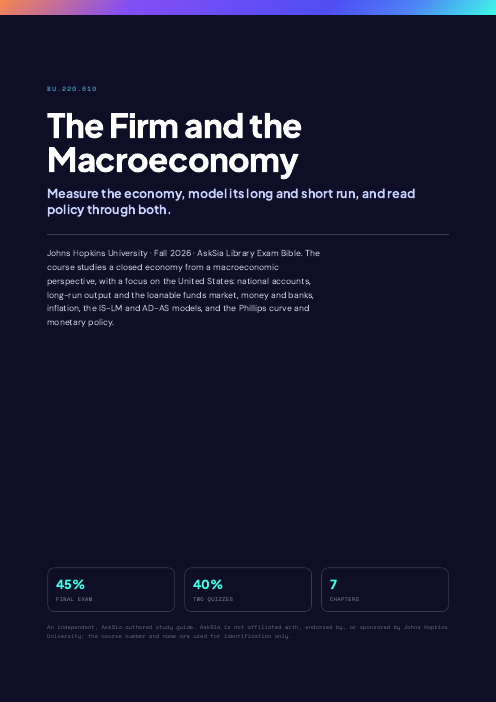
38 chapter pages · 3 subject areas

Topics, worked examples and key terms carry across offerings. Assessment weights and dates change between offerings, so confirm yours on the LMS. Last updated 21 October 2026.

All 4 Johns Hopkins University course guides

Grouped by discipline. These are AskSia topic categories, not Johns Hopkins University faculties or departments.

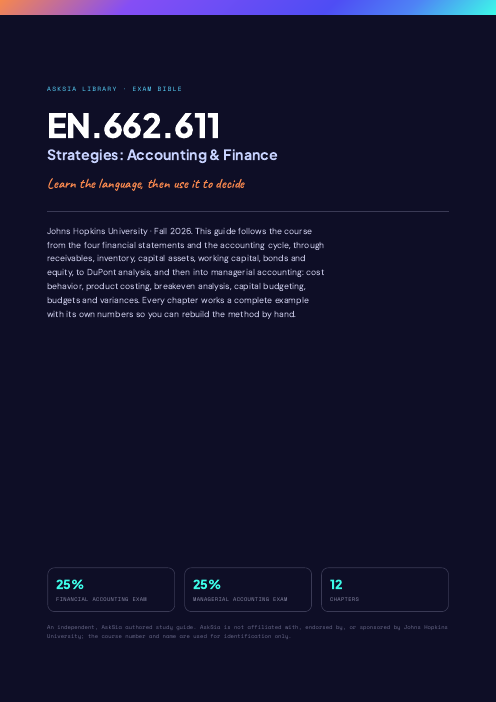
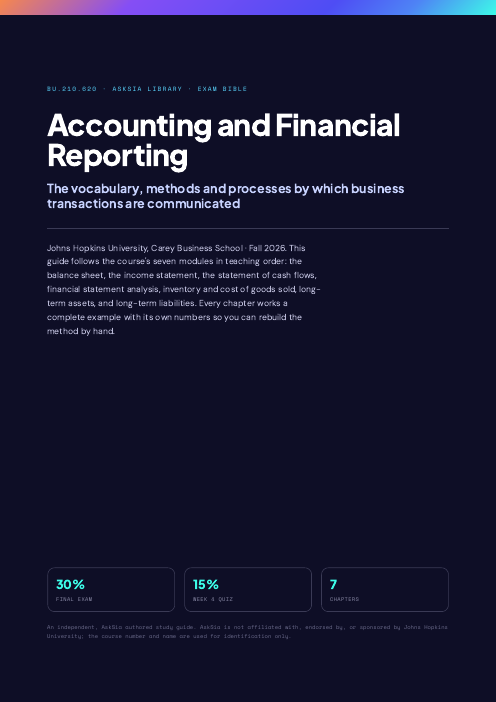
Accounting2 courses

Economics1 course

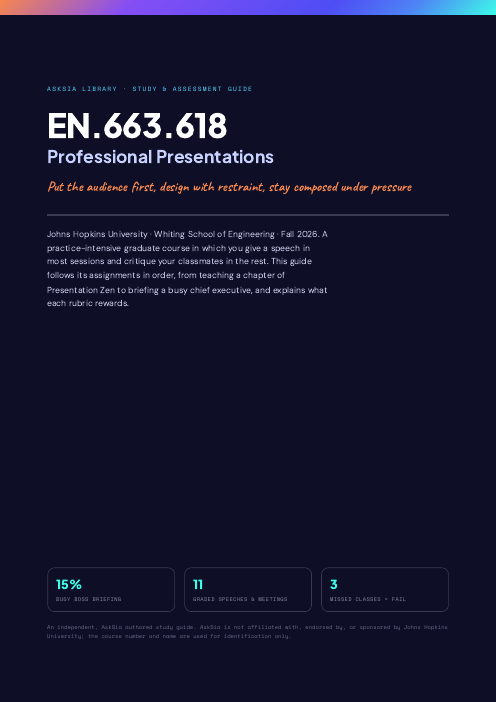
Media and Communications1 course

Courses grouped by how they are assessed

Read from the published assessment table of 4 of the 4 courses. 0 of them carry at least one hurdle, marked below.

One exam carries half the marks or more0 courses

    No subjects in this group.

    There is an exam, but coursework carries more2 courses

    No final exam2 courses

    How assessment works at Johns Hopkins University

    Where do the weights on these Johns Hopkins guides come from?

    From the syllabus for the section and term the guide names. Carey and Whiting syllabi are read the same way: the grading table is reproduced, each item is labelled with its weight, and the syllabus file is cited.

    Why is the top grade an A and not an A+?

    Because the Carey Business School grading policy states that an A+ is not awarded at any level; A carries 4.00, A minus 3.70, B+ 3.30 and B 3.00. Carey also caps the class average: a core or foundation course should not exceed a 3.35 grade point average and an elective 3.45, and a cumulative GPA below 2.85 makes a student ineligible to graduate.

    When are exams in Fall 2026?

    On the Homewood semester calendar classes end on December 11, Reading Day is December 14 and Exam Days run December 15 to 23. Carey runs eight week terms instead, and Fall Term 2 runs October 27 to December 23, so a Carey final lands at the end of its term rather than in a shared exam week.

    What do BU and EN mean in a course number?

    The division that owns the course. BU.210.620 is a Carey Business School course, EN.662.611 and EN.663.618 belong to the Whiting School of Engineering, and AS numbers belong to the Krieger School of Arts and Sciences. Guides keep the full dotted number in the title so it matches SIS.

    Is AskSia part of Johns Hopkins University?

    No. AskSia is not affiliated with Johns Hopkins University or any of its schools. Each guide is an independent study aid written from the syllabus and materials it cites, and every figure names the term it was read from.
    Past exams at Johns Hopkins

    Johns Hopkins does not keep a university wide archive of past exams; instructors release samples, if any, inside their own Canvas sites. AskSia guides rebuild the assessment from the syllabus instead. For Carey Business School courses that means the eight week term calendar and the grading policy with its class average caps; for Whiting School courses it means the semester calendar with Reading Day and the exam days. Each guide says which calendar it follows.

    Johns Hopkins at a glance

    Location
    Homewood campus, Baltimore, Maryland; Carey Business School at Harbor East, Baltimore, and in Washington, DC
    Official site
    https://www.jhu.edu
    Academic catalogue
    https://e-catalogue.jhu.edu