DNA contains exactly two purines: adenine and guanine. Both are built from a nine-atom double ring holding four nitrogen atoms, and both appear unchanged in RNA. The two pyrimidines in DNA, cytosine and thymine, each carry a single six-membered ring.
Those three numbers do more work than the two names. The 50% figure holds in every genome sequenced to date, the 2 nm diameter is the reason purines cannot pair with each other, and the nine-atom count is the fastest way to identify a purine on sight.
What Are the Two Purines in DNA?
Adenine carries an amine group at carbon 6 of its six-membered ring. Formula C5H5N5, molar mass 135.13 g/mol. In DNA it pairs with thymine.
Guanine adds one oxygen. It is a 2-aminopurine with a 6-oxo substituent, formula C5H5N5O, molar mass 151.13 g/mol. It pairs with cytosine.
Guanine was first isolated from bird guano. That is where the name came from.
Both bases attach to deoxyribose through nitrogen 9. Pyrimidines attach through nitrogen 1. That difference in attachment point is what swings the larger base into the correct orientation inside the helix.
The 16 g/mol gap between them is one oxygen atom. That oxygen is also the third hydrogen bond donor site, which is why guanine grips its partner harder than adenine does.
How Do Purines Differ From Pyrimidines?
A purine is a six-membered pyrimidine ring fused to a five-membered imidazole ring. The fused system holds nine atoms: five carbons and four nitrogens, sitting at positions 1, 3, 7 and 9.
A pyrimidine is one ring. Six atoms, four carbons, two nitrogens at positions 1 and 3.
The naming causes trouble. Pyrimidine is the longer word and the smaller molecule, and the pyrimidine ring is also one half of every purine. Students who reason from word length get it backwards.
Read down the ring column and the answer to the original question falls out. Two entries carry a 2. Those two are the purines.
Why Must Purines Pair With Pyrimidines?
Geometry decides it. B-form DNA holds a diameter of 2 nm, or 20 Å, and that width does not vary from one rung of the ladder to the next. Base pairs stack 0.34 nm apart, with 10 pairs per 3.4 nm turn.
A uniform width demands a uniform number of rings across each rung. One purine plus one pyrimidine gives three rings every time.
Pair two purines and you get four rings, which forces the two sugar-phosphate backbones apart. Pair two pyrimidines and you get two rings, leaving a gap the hydrogen bonds cannot reach across. Neither arrangement survives in a stable duplex.
Size complementarity is only half the constraint. The donor and acceptor atoms also have to line up.
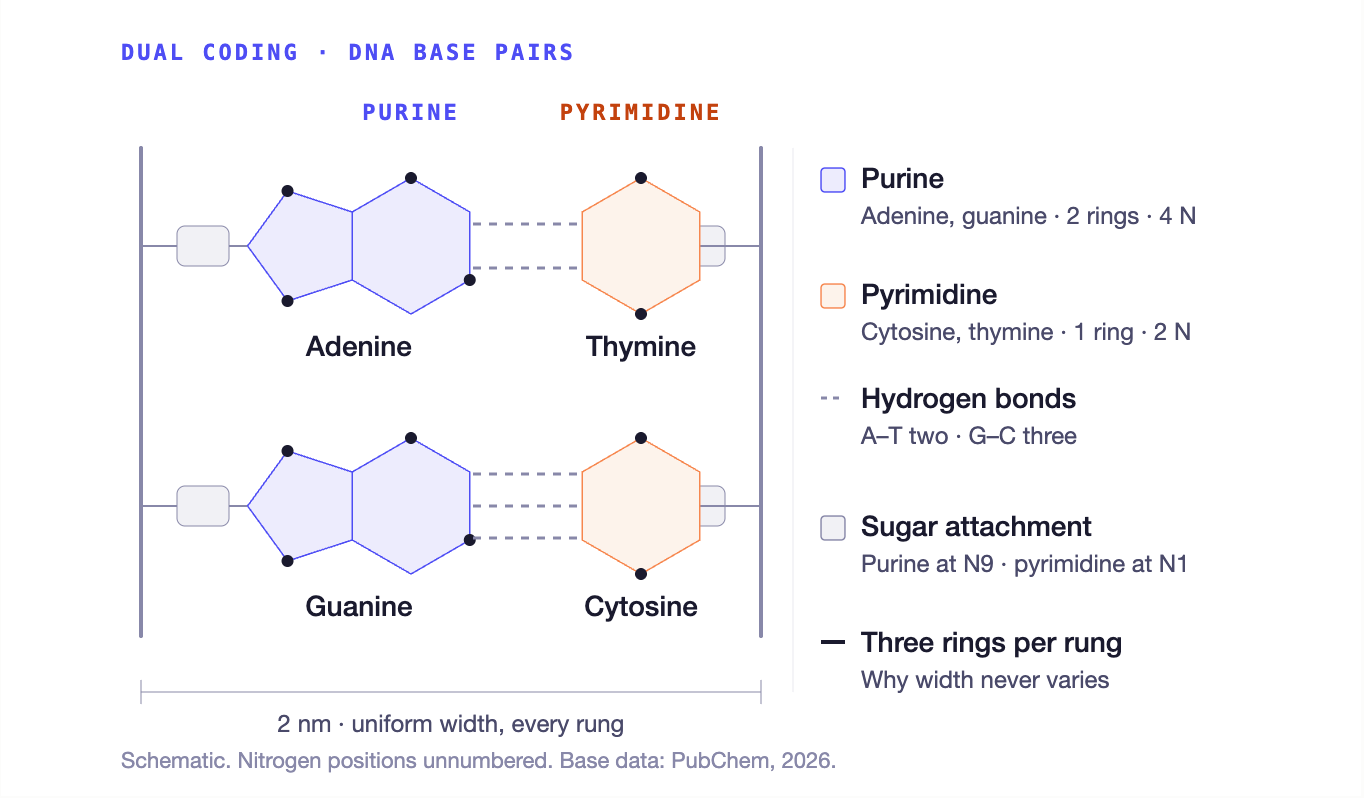
Adenine and thymine form two hydrogen bonds, at N6 to O4 and N1 to N3. Guanine and cytosine form three, at N1 to N3, N2 to O2 and O6 to N4. Swap the partners and the donors face donors.
That third bond has a measurable thermal consequence. Under the Marmur-Schildkraut relationship, each percentage point of GC content raises the melting temperature of a DNA sequence by roughly 0.41 °C. A 60% GC amplicon melts around 8 °C higher than a 40% GC amplicon of the same length, which is the reason PCR primer design targets 40–60% GC.
What the pairing rule does not do is shift the mass of the molecule much. Summing the PubChem values, an A-T base pair comes to 261.24 g/mol and a G-C base pair to 262.23 g/mol. That is a difference of 0.98 g/mol, or 0.4%.
So a genome that is 20% GC and a genome that is 72% GC weigh almost exactly the same per base pair. Composition changes stability and sequence, not bulk.
Worth conceding one thing here. Erwin Chargaff's own measurements were not the clean identities the rule is usually taught as. His human DNA figures ran 30.9% adenine against 29.4% thymine, and 19.9% guanine against 19.8% cytosine. The adenine and thymine values sit 1.5 points apart, a gap attributable to 1950s analytical error rather than biology. The rule is an empirical near-equality that the Watson-Crick model later explained, not an axiom that came first.
Does Purine Content Vary Between Species?
The total does not. The split does, and by a wide margin.
Because Chargaff parity forces A to equal T and G to equal C, purines account for close to 50% of bases in every double-stranded genome regardless of how AT-rich or GC-rich it is. What moves is which purine dominates.
Read the last two rows against each other. Streptomyces carries nearly four times the guanine share of the malaria parasite, and exactly the same purine share.
Exam questions exploit this. A stem giving 20% cytosine expects you to reach 20% guanine, then 60% split evenly between adenine and thymine at 30% each. Purines land at 50% either way. Mapping how this connects to replication and transcription is the kind of chapter-level dependency that AskSia's Concept Map lays out as a navigable tree rather than a linear reading list.
How Can You Remember Purines Reliably?
Two mnemonics circulate for this, and only one survives inspection.
Pure As Gold gives you A and G, which is correct, but the chemical symbol for gold is Au. The image and the letters do not match, so the cue decays.
Pure Silver works better, because silver is Ag. Adenine and guanine, in order, in a real element symbol you already know from the periodic table.
For the pyrimidines, CUT the pie covers cytosine, uracil and thymine.
Mnemonics are a fallback though. The durable move is a structural check that regenerates the answer instead of retrieving it: count the rings. Two fused rings means purine, and DNA has exactly two of them. One ring means pyrimidine. That check also survives into questions about inosine, xanthine and hypoxanthine, where no mnemonic helps.
Once the ring check is automatic, drill the pairing partners and hydrogen bond counts with AskSia's Flashcards, which schedule reviews against your exam date using FSRS rather than a fixed interval.
Where Do Exam Questions Trip Students?
Five failure modes account for most lost marks on this question. Four are confusions, and one is a reasoning error about composition.
The third row is the one worth rehearsing. A question that asks for "the purines in RNA" is testing whether you know the answer did not change.
Sitting these in real stem format helps more than reading them. AskSia's Mock Exam mode grades in the question style of the paper you are actually taking, whether that is AP Biology or the MCAT, and returns the rationale rather than just the mark.
What Does This Model Leave Out?
The two-purine answer is correct and incomplete. Real genomes carry chemically modified versions of all four bases.
5-methylcytosine, a modified pyrimidine, is the central mark in mammalian epigenetics. 8-oxoguanine is a modified purine produced by oxidative damage, and it mispairs with adenine, which is one route to point mutation.
Purine chemistry also reaches past DNA. Adenine sits inside ATP, NAD, FAD and coenzyme A. Purine breakdown ends at uric acid, whereas pyrimidine breakdown yields freely soluble products, and that asymmetry is why gout is a purine disorder and has no pyrimidine equivalent.
Watson-Crick pairing is not the only arrangement either. Hoogsteen pairs use a different face of the purine, and four guanines can assemble into a G-quadruplex at telomeres and in promoter regions. Neither fits the three-rings-per-rung picture.
For a first-year exam, the ring count and the pairing partners will carry you. Anything beyond that is second-year material, and the sequence in which it arrives is set by your unit guide rather than by the textbook. Comparing the two, subject by subject, is straightforward with AskSia's Sia Note, which compresses a chapter into concept, risk and worked example.
Frequently Asked Questions
What are the two kinds of purines in DNA?
Adenine and guanine. Both are bicyclic, built from a six-membered pyrimidine ring fused to a five-membered imidazole ring, giving nine ring atoms of which four are nitrogen at positions 1, 3, 7 and 9. Adenine has formula C5H5N5 and molar mass 135.13 g/mol, carrying an amine group at carbon 6. Guanine has formula C5H5N5O and molar mass 151.13 g/mol, carrying an amine at carbon 2 and an oxo group at carbon 6. Both attach to deoxyribose through nitrogen 9. Both also appear in RNA without modification, which is a point exam stems test regularly. Beyond these two, hypoxanthine and xanthine are purines that function as metabolic intermediates but are not incorporated into nucleic acid strands. Check your unit guide to see whether those intermediates are examinable in your course, since coverage varies between first-year biology and biochemistry papers.
What are two purines and two pyrimidines?
The two purines in DNA are adenine and guanine. The two pyrimidines are cytosine, formula C4H5N3O at 111.10 g/mol, and thymine, formula C5H6N2O2 at 126.12 g/mol. Uracil is a third pyrimidine that replaces thymine in RNA at 112.09 g/mol. Pairing runs adenine to thymine with two hydrogen bonds, and guanine to cytosine with three. Every pair puts one purine opposite one pyrimidine, which is what holds the B-DNA helix at a constant 2 nm diameter across all 10 base pairs per turn. The quickest way to sort them under time pressure is the ring count: two fused rings means purine, one ring means pyrimidine. Our Bio 101 cheatsheet holds these values in one place for revision.
How do you remember purines vs pyrimidines?
Use a cue that maps to something already stored. Pure Silver works because silver is Ag, giving adenine and guanine in order. Pure As Gold gives the same two letters but gold is Au, so the image contradicts the symbol and the cue erodes under exam pressure. For the pyrimidines, CUT the pie covers cytosine, uracil and thymine. Better than either is the structural check, since two fused rings always means purine and DNA holds exactly two. That check regenerates the answer rather than retrieving it, and it still works on hypoxanthine and inosine where no mnemonic applies. Pair it with paired visual and verbal encoding rather than rereading, a technique covered in our guide to active recall. Build the ring diagram once by hand, then test yourself against a blank version.
What are the purines in the DNA model?
In a paper or ball-and-stick DNA model, adenine and guanine are the two wider base cutouts, drawn with two fused rings rather than one. Standard classroom kits colour-code them, commonly green for adenine and yellow for guanine, though colour conventions vary by supplier and carry no chemical meaning. What is fixed is width: every rung must show three rings total, one purine plus one pyrimidine, which is how the model reproduces the uniform 2 nm helix diameter. If your model has two wide bases facing each other, the assembly is wrong. Attachment matters too. Purines connect to the deoxyribose at nitrogen 9, pyrimidines at nitrogen 1. Before submitting a model assignment, count rings across every rung and confirm each total is three.
Is uracil a purine or a pyrimidine?
Uracil is a pyrimidine. It has one six-membered ring with two nitrogen atoms, formula C4H4N2O2 and molar mass 112.09 g/mol. It appears in RNA, where it replaces thymine and pairs with adenine. Thymine is 5-methyluracil, so the only structural difference between them is a methyl group at carbon 5, which adds 14 g/mol and brings thymine to 126.12. Listing uracil as a purine is one of the most frequent errors on this question, and it usually comes from associating uracil with RNA and then assuming the purines changed as well. They did not. Adenine and guanine are the purines in both DNA and RNA. If you are working through nucleic acid structure for a first-year unit, our BIOL10008 guide maps where this material sits in the semester.
Why do purines only pair with pyrimidines?
Two constraints act at once. Size first: B-DNA holds a uniform 2 nm diameter, and only a nine-atom purine opposite a six-atom pyrimidine produces the three rings per rung that width requires. Two purines are too wide and two pyrimidines leave a gap the hydrogen bonds cannot bridge. Geometry second: hydrogen bond donors have to face acceptors. Adenine and thymine align at two positions, N6 to O4 and N1 to N3. Guanine and cytosine align at three, N1 to N3, N2 to O2 and O6 to N4. Any other combination puts donor against donor. The consequence is measurable, since each percentage point of GC content raises melting temperature by around 0.41 °C. For structural questions like this one, work through the course hub for your unit alongside a diagram rather than prose alone, and see our biology study method guide for how to sequence that.